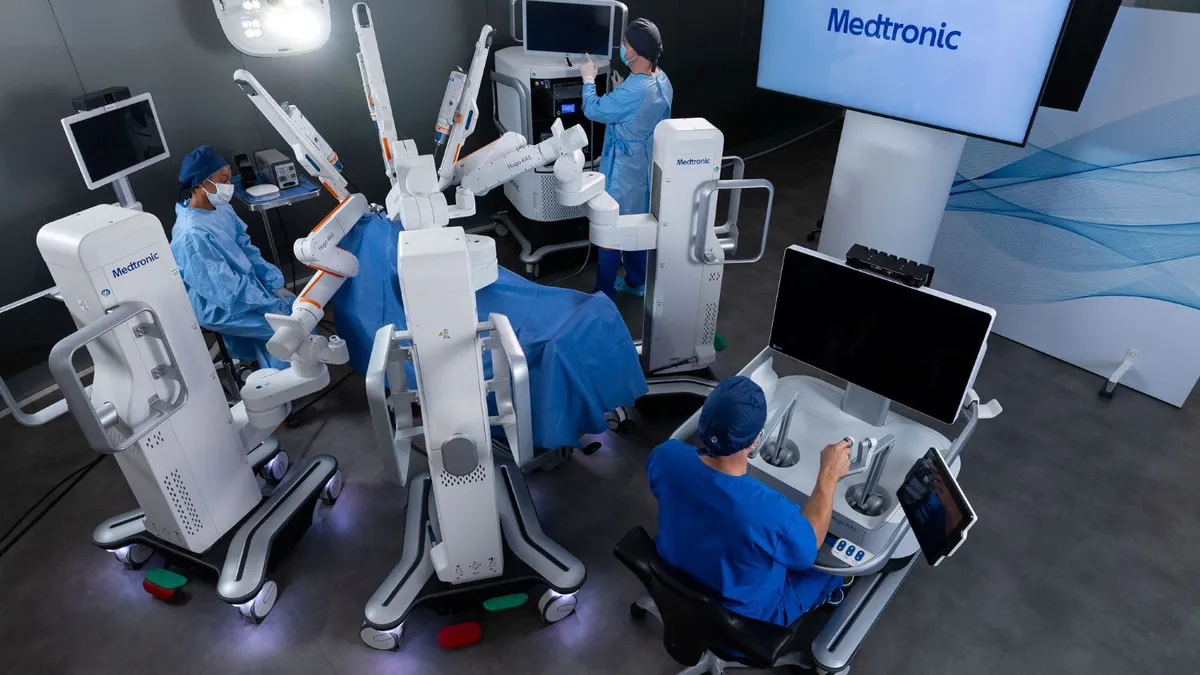
Healthcare providers looking to build soft tissue robotic surgery programs saw their options multiply in the past year.
When Medtronic and another deep-pocketed robot developer, CMR Surgical, snagged Food and Drug Administration nods in December, it capped off a steady succession of regulatory clearances and submissions, funding rounds and clinical trial launches for companies advancing new systems for minimally invasive surgery. The momentum continued in the new year as Johnson & Johnson submitted its Ottava robot for FDA authorization.
An ongoing shift to robotic assistance, which enables soft tissue surgery to be performed through small incisions, is expected to help reduce complications, improve outcomes and shorten recovery times for patients. Companies are developing platforms to bring greater precision to an increasingly diverse range of procedures.
What impact the new systems will have on Intuitive Surgical, the robotic surgery market leader for more than two decades, is the subject of much debate.
Here are five trends to follow in surgical robotics in 2026:
1. Startups are going where Intuitive is not
Two tiers of companies are emerging in robotic surgery: large multinationals that will challenge Intuitive head-on in the soft tissue race, and smaller competitors working to differentiate themselves in specialized uses.
Medtronic and J&J fall into the first category, said industry expert Steve Bell, an adviser to medtech startups, but large companies that are less well known in the U.S., such as Shanghai-based MicroPort MedBot and Japan’s Medicaroid — a joint venture of Kawasaki Heavy Industries and Sysmex — are also increasing their global reach.
In the second category, smaller companies will try to go where Intuitive is not, said Bell. He predicted the biggest area of differentiation in 2026 will be new sites of care. Companies may pursue certain hospitals that have not yet established a robotics program.
New market entrants are also rushing to gain a foothold in ambulatory surgery centers, where more procedures are taking place but robots have historically lacked a presence, Bell said. In the outpatient-focused ASCs, sidestepping Intuitive could mean “the fight will be easier,” said Bell. Distalmotion and Moon Surgical are two robot makers targeting ASCs as part of their strategies, he said, and Virtual Incision and CMR likely will do so as well.
CMR expects its Versius system to find a home in both ASCs and hospitals looking for a smaller, portable robot that can be moved between departments, CEO Massimiliano Colella said.
“There are an increasing number of hospitals that basically are telling us that this modularity will really fit into the idea that they have of a robotic program,” said Colella. “My takeaway — they see it as complementary to whatever they already have in place.”
Intuitive has ASCs in its sights as well. On an earnings call last week, executives said the company is prioritizing expansion in higher-volume ASCs.
2. Medtronic will gain commercial traction
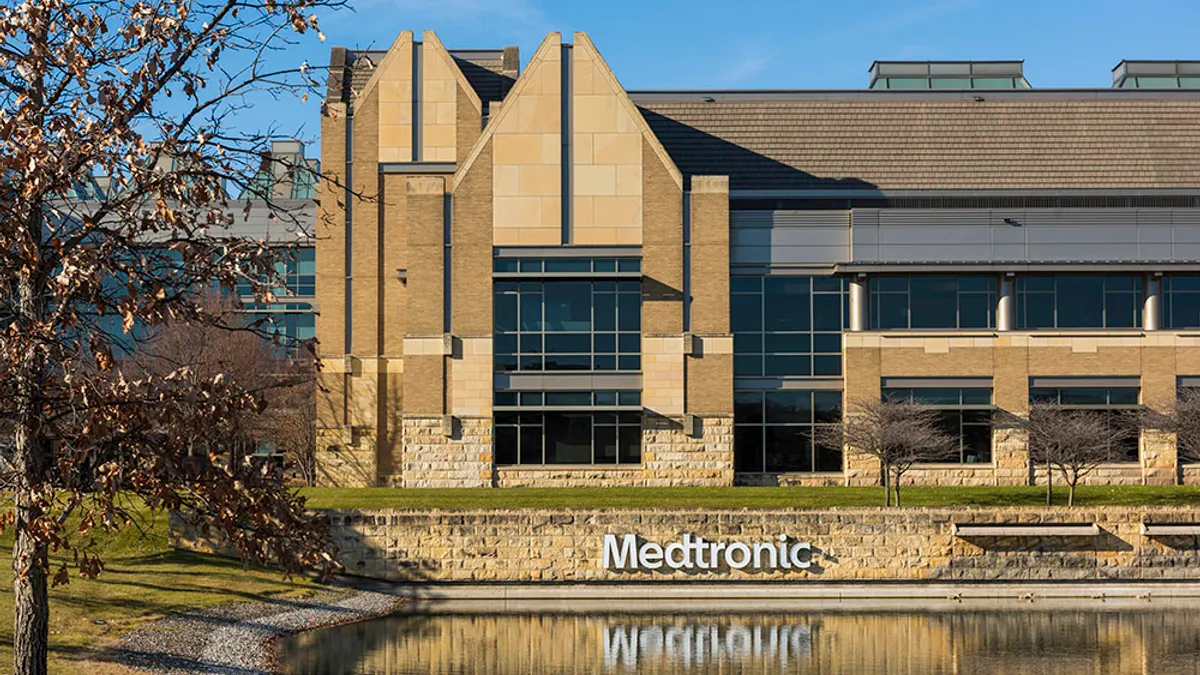
In December, Medtronic became the first large medtech company positioned to take on Intuitive in the U.S. when it secured FDA clearance for the Hugo robotic assisted surgery system in urology. Medtronic will also seek indications in general surgery and gynecology.
Rajit Kamal, Medtronic vice president and general manager of robotic surgical technologies, said Hugo’s U.S. rollout will be similar to its global introduction.
“We are taking a purposeful approach to launching the Hugo RAS system in the U.S., beginning with select, leading institutions,” Kamal said in an email. “This will allow us to establish a strong foundation of success for customers and their patient care.”
Of the roughly 50 million soft tissue surgeries that will be performed this year, about 30 million will be done as open surgery, the Medtronic executive said, so there is still a significant global need to expand access to minimally invasive surgery.
“Even in the U.S., which has the highest adoption of RAS in the world, hospitals are facing capacity and access challenges as they seek to offer minimally invasive surgical options to more patients,” said Kamal. With Hugo, and through its global scale, strong training partnerships and broad technology offerings, Medtronic can help address those challenges, he said.
Bell, the startup adviser, expects interest in Hugo to come from loyal Medtronic customers comfortable with its surgical instruments, academic institutions and some surgeons who are not using an Intuitive robot.
“The impact of Medtronic this year, and J&J next year, will be meaningful,” said Bell. “It will be meaningful in a small percentage, but it will be meaningful.”
3. Intuitive is up to the challenge
Jefferies analyst Matthew Taylor said it could be two to three years before the competitive landscape really heats up.
“You do have Medtronic with the U.S. approval now, and they're going to move ahead with a limited launch and have signaled that there really may be some impact next year for them on their growth,” said Taylor. “And then J&J is in the process of getting approval, but they probably won't have a more material impact at least for their growth until 2028.”
As competition rises, Intuitive continues to innovate, adding new features to its robots such as a video replay capability to inform real-time decision-making, a gauge measuring the force applied to tissue and additional surgical tools. “I like our chances,” Intuitive CEO Dave Rosa told investors this month at the J.P. Morgan Healthcare Conference.
Intuitive provided a 2026 worldwide da Vinci procedure growth forecast of about 13% to 15%, below last year’s approximately 18% growth rate, but did not call out U.S. competitive pressures. Instead, executives pointed to potential impacts from changes to Affordable Care Act premium subsidies and Medicaid funding, capital challenges in Europe and Japan, and competition in China.
Taylor said the robot maker typically begins the year with a conservative outlook and will likely outperform its 2026 forecast, supported by continued adoption of da Vinci 5. “Then in 2027, you'll see the rubber start to meet the road with the competition,” he said.
4. Expect cardiac surgery to benefit
Cardiac surgery is shaping up as a key area for investment in the year ahead.
Intuitive in the past week unveiled a plan to step up its presence in cardiac surgery after receiving FDA clearance for nine new indications in the specialty, including mitral and tricuspid valve repair, mitral valve replacement, and left atrial appendage closure.
The move comes as other robot developers, such as SS Innovations International, Capstan Medical, and Corcym and CardioPrecision, eye large market opportunities in the space.
Intuitive plans a limited U.S. rollout for the initiative in 2026 as it ramps up training programs for cardiac teams in certain hospitals. The company also intends to develop cardiac-specific instruments.
On an October earnings call, Rosa said da Vinci 5’s strengths in motion control, advanced imaging and artificial intelligence integration, coupled with new surgical instruments in development, could make a difference for cardiac surgeons and their patients.
“Where those two intersect — our capabilities plus an unmet need — I think that's where some magic can happen,” Rosa said.
5. Specialized applications are growing
Intuitive’s da Vinci robots are commonly used in urologic, gynecologic and general surgery. Companies are now expanding the frontiers of robotics into more surgical categories. Among those to get new FDA clearances last year were Microbot, creator of a robot for peripheral endovascular procedures, and Stereotaxis, whose magnetic navigation technology is used in ablations to treat heart arrhythmias.
Bohdan Pomahac, chief of plastic and reconstructive surgery and director of the face transplant program at Yale Medicine, leads the post-market study for MMI’s Symani system, a robot that enables surgeons to reconnect tiny blood vessels.
Pomahac said new robots are allowing surgeons to perform high-precision movements previously only feasible for the most talented and well-trained specialists. “The technology lowers the bar of who can do very complex procedures, so the learning curve is faster,” said Pomahac. “It also allows us to deploy it in situations that you would not normally be comfortable with.”
In the field of ophthalmology, new robots could help offset a projected decline in the number of eye surgeons in the next decade, said Joseph Nathan, co-founder and chief medical officer of ForSight Robotics, which is developing a platform for cataract surgery.
“ForSight Robotics will be able to provide the ability for surgeons to do many more procedures, to be more efficient,” Nathan said.
Companies such as ForSight are re-engineering the procedure through robotics, said Nathan, adding that advances in AI, visualization technology and the miniaturization of mechanics will make it possible to elevate the level of care that patients receive.
“We’re seeing more and more specialized robots,” said Nathan. “As a surgeon, I think that patients deserve to have the best technology delivered through healthcare.”