Dive Brief:
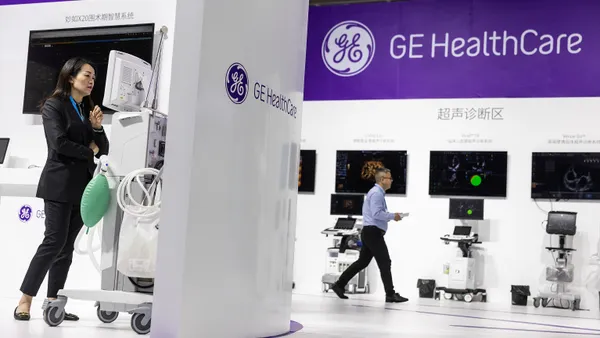
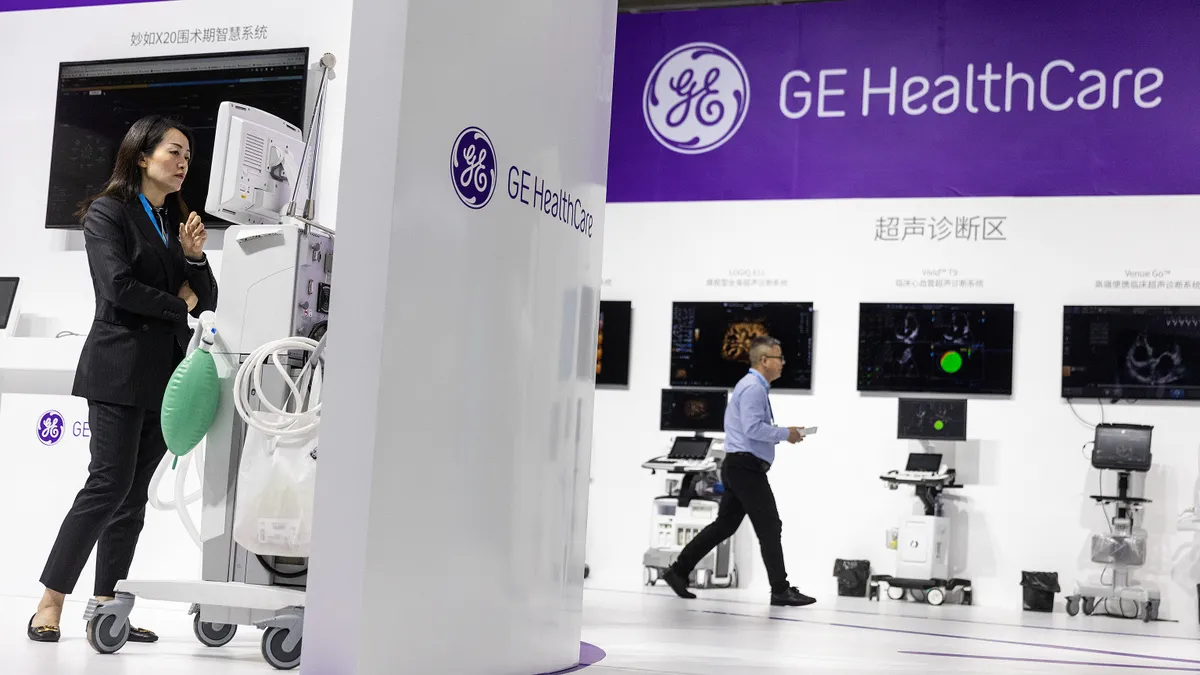
- GE HealthCare has won a $35 million U.S. government contract expansion to develop artificial intelligence-enabled ultrasound technology for trauma care, the company said Tuesday.
- Building on a deal made in 2023, GE HealthCare will develop AI-powered tools to make it faster and easier for people, including non-expert ultrasound users, to diagnose patients.
- GE HealthCare is jointly funding the latest phase of the project, although it said the Biomedical Advanced Research and Development Authority will provide most of the money.
Dive Insight:
GE HealthCare and BARDA struck a $44 million deal in 2023 to fund development of tools for diagnosing patients in mass casualty incidents. Under the original agreement, GE HealthCare worked on AI-enabled algorithms for the noninvasive detection of intracranial pressure and the assessment of abdominal and lung injuries.
The goals of the expanded agreement include enabling more detailed assessments of lung pathologies, including pleural pathologies, and improving detection of intra-abdominal injuries. GE HealthCare will also work to improve the reliability and usability of point-of-care ultrasound technologies in demanding environments, including field-based care settings.
GE HealthCare said the latest agreement is covered by the same contract as the original 2023 deal. The government last updated the public record in June, when it committed $26.9 million to exercise certain options and revise the statement of work. BARDA lists the total value of the deal as $64 million.
The BARDA deals are part of a broader push into AI. Over the past two years, GE HealthCare has struck deals to buy Intelerad for $2.3 billion, Icometrix for about $98 million upfront and MIM Software for about $259 million, with additional milestone payments. The takeovers cover AI-enabled imaging technologies.
GE HealthCare CEO Peter Arduini discussed the focus on AI and the deal to buy Intelerad on an earnings call this month.
“These are the types of deals that we think make a lot of sense for the company relative to a strategic fit for us, the enablement of artificial intelligence to be deployed at an enterprise level, both inpatient and outpatient,” Arduini said. “We know the future of diagnosis is much more the integration of multi-modalities and how they're read, and so having a critical platform such as this will be super important for us.”
Arduini added that there is “a flywheel effect” as the company launches AI-enabled devices. The capture rate on service contracts “typically goes up” when AI devices come to market because the products are “very sophisticated,” Arduini said. GE HealthCare has warned investors its increasing investment in AI creates risks, adding that it may fail to drive global deployment and adoption of the technologies.