Editor’s note: This is the fifth article in a series of stories profiling medtech companies that are changing the field of robotic surgery. Read the other profiles here.
Days after being named CEO at CMR Surgical, Massimiliano Colella faced a difficult decision.
CMR was about to launch its Versius surgical robot in the U.S. The robot had just secured Food and Drug Administration authorization for its initial indication in soft tissue surgery, and the company was preparing to line up its first U.S. hospital partners.
The new CEO, however, chose not to go ahead with the rollout.
“It was basically the same week I was appointed CEO of the company,” said Colella. “I actually stopped it, as a first decision that I took, because I didn't want to launch the generation one of Versius. I wanted to wait for Versius Plus.”

Colella, who was named interim CEO in late 2024 before taking over the role permanently in January 2025, needed to be certain the robot’s U.S. debut could meet the market’s high expectations. Looking back, waiting for the more advanced system to be ready was the right thing to do, he said, even though halting the release delayed market entry by a year.
“It’s a market where we cannot afford a single mistake,” said Colella.
Now, with FDA clearance for Versius Plus in hand, CMR this year will attempt to establish a foothold in the U.S. The company’s arrival comes at a critical juncture for the U.S. market, as a growing number of robot developers, including medtech giants Medtronic and Johnson & Johnson, are poised to give industry leader Intuitive Surgical the first competition on its home turf since it pioneered the da Vinci system in the early 2000s.
Elsewhere, Cambridge, England-based CMR has found success in an increasingly crowded global surgical robotics field. Versius is the second most widely adopted robot outside of the U.S., according to the company. The platform received Europe’s CE mark in 2019 and has been used to perform more than 40,000 procedures in more than 30 countries worldwide.
Investors, confident in CMR’s potential and the future of robotic surgery, have poured almost $1.5 billion into the company to support the development and commercialization of Versius, making CMR the top-funded venture capital-backed surgical device business, according to PitchBook.
Scrapping the first U.S. launch gave CMR more time to fine-tune Versius, learn the market and chart the course for its expansion, said Colella. New surgical instruments and data tracking tools, enhanced visualization technology and greater system efficiencies are among the improvements in the second-generation platform. The robot is now “super performing,” said Colella. Most of the changes can also be transferred to customers with the original Versius system through a software upgrade.
In robotics, getting the best performance from a system is a step by step process, said the CEO. “This is something that nobody can avoid,” Colella said.
CMR’s updated robot won FDA clearance in December for gallbladder removal surgery, its initial indication. The company is also pursuing 510(k) submissions with the FDA for gastrointestinal surgery, gynecology, urology and general surgery, with clearances expected this year.
As it begins a U.S. soft launch for Versius Plus, CMR is choosing its first partners among hospitals and ambulatory surgery centers. A full market rollout will follow as indications for more surgical specialties are received.
“We have, I must say, a very healthy queue of centers that want to work with Versius,” said Colella.
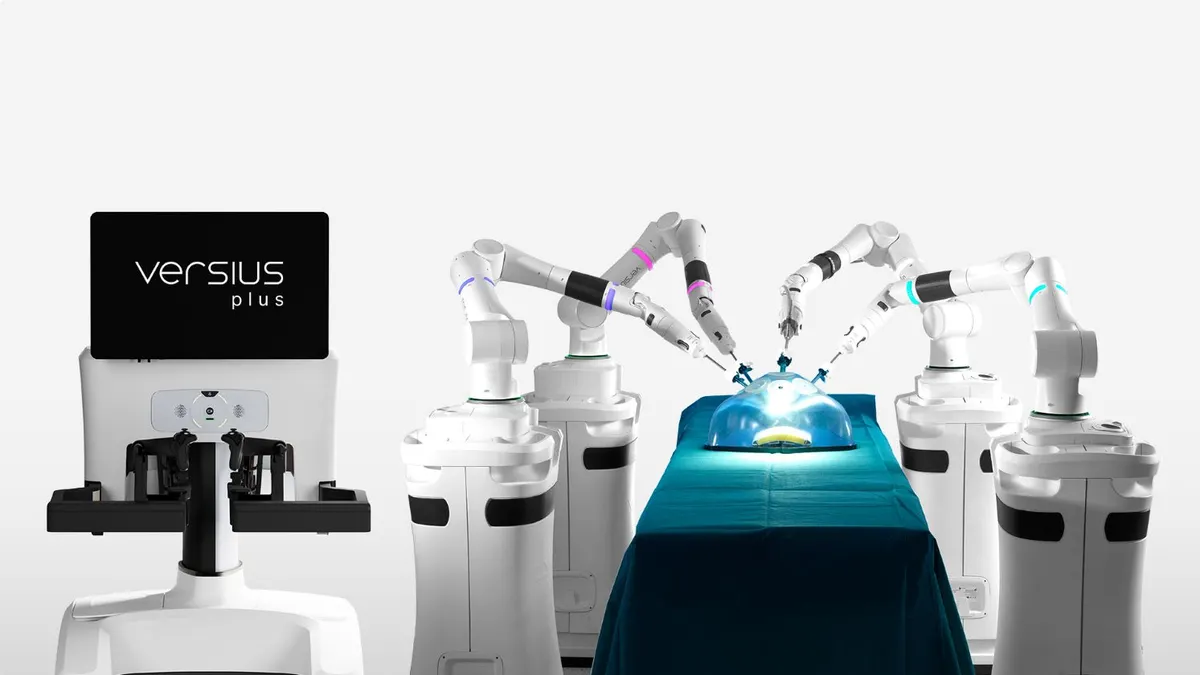
The robot is designed to replicate minimally invasive laparoscopic surgery, where procedures are performed via tiny incisions. The small and modular system is portable, so it can be shared between operating rooms.
Colella said hospitals view Versius as complementary to robotic programs they already have in place.
“Huge hospitals with a high number of ORs, sometimes they have got the first one, the second one, the third one, and then they realize, ‘OK, we cannot keep going this way and having 20 robots, but we could have one which is portable, that we could move,’” he explained.
Departments within the hospital that lack full access to a robotic program because it is dominated by other specialties could work with a portable robot on a rotational basis.
“The reason why we are very optimistic about our chances, in the U.S. market and everywhere in the world, is because we are fully differentiated products, vis-à-vis Intuitive,” said Colella.
Yet while CMR will compete with Intuitive, Colella is quick to emphasize that the company is not coming to the U.S. to challenge the robotic surgery market’s creator. “We are coming because we know that this market is going to become so big around the world that we truly believe that there is space for us based on the features and benefits that we can offer,” he said.
The increased competition in surgical robotics, brought by CMR and others, will accelerate the market’s overall growth and will likely make robotic systems more affordable for many more hospitals globally, said Colella.
“We will — I wouldn't say easily — but we'll find our space to become a big company without challenging anyone, just positioning ourselves for the benefit of customers and patients,” he said.