Dive Brief:
- Novocure has won Food and Drug Administration approval for its tumor treating field technology in locally advanced pancreatic cancer, the company said Wednesday.
- The FDA authorized the device, Optune Pax, based on a trial that linked the technology to a statistically significant two-month improvement in overall survival. The device was authorized through the agency’s premarket approval pathway.
- Novocure CEO Frank Leonard said last month that the market includes about 15,000 patients in the U.S., making the opportunity slightly larger than the company’s core brain cancer business.
Dive Insight:
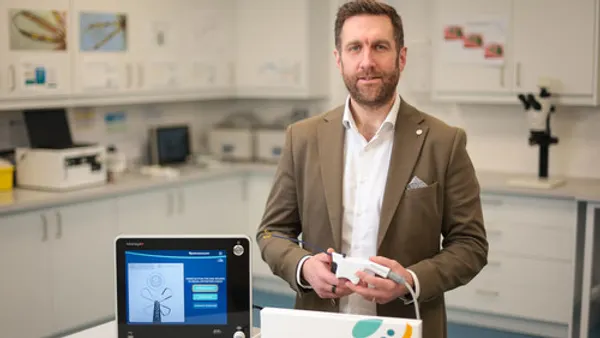
Novocure has developed technology that uses alternating electric fields to disrupt the proliferation of cancer cells. The low-intensity electric fields disrupt cellular processes critical to rapidly dividing cancer cells, thereby treating tumors while minimizing damage to healthy tissue. The FDA approved a device based on the technology, NovoTTF-100A, to treat glioblastoma multiforme, or GBM, brain tumors in 2011.
Subsequent authorizations expanded the eligible GBM population, moved Novocure into new indications and covered updated versions of the technology. Novocure expanded into locally advanced pancreatic cancer by testing the technology with the chemotherapy drugs gemcitabine and nab-paclitaxel.
The GBM and pancreatic cancer devices both deliver electric fields to disrupt cancer cells. In GBM, the therapy is administered by applying adhesive bandages that hold insulated ceramic discs to the skull. The pancreatic cancer therapy is administered through adhesive patches applied to the torso.
In a study of 571 patients, Novocure saw median overall survival of 16.2 months in adults who received tumor treating field therapy with gemcitabine and nab-paclitaxel, compared with 14.2 months in patients who only took the chemotherapy drugs. The difference in OS was statistically significant, achieving the trial’s primary endpoint, but the device had no effect on progression-free survival or the response rate.
Pain-free survival was significantly longer in the tumor treating field arm, 15.2 months versus 9.1 months in the control group. Leonard said at the J.P. Morgan Healthcare Conference last month that “pain-free survival is one of the most meaningful clinical endpoints for patients.”
The approval could diversify Novocure’s sales beyond GBM. The company won approval in mesothelioma in 2019 and in metastatic non-small cell lung cancer in 2024, but GBM is still its main indication. Optune Lua, the mesothelioma and NSCLC device, accounted for $3.5 million of the $174.4 million in sales that the company reported in its preliminary fourth-quarter results.
Winning approval to target the 15,000 U.S. patients with locally advanced pancreatic cancer is the first step in a broader expansion in the tumor type. Leonard said Novocure will publish top-line data from a trial in first-line metastatic pancreatic cancer in the first quarter of 2026.