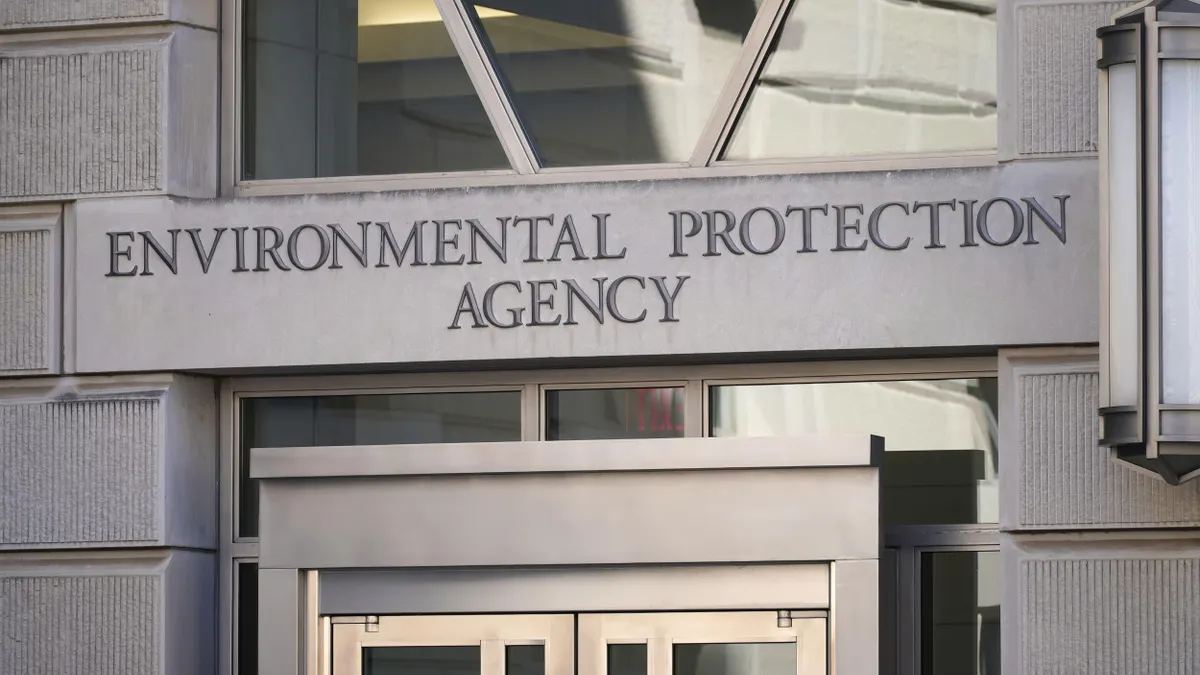
Scientists, clinicians and community members urged the Environmental Protection Agency not to weaken emissions standards for ethylene oxide, a cancer-causing gas that is used to sterilize about half of all medical devices used in the U.S.
The EPA held a Wednesday public hearing on the agency’s plans to reconsider a 2024 rule on ethylene oxide, or EtO, emissions from commercial sterilizer facilities. Speakers with the Alliance of Nurses for Healthy Environments and the American Lung Association urged the EPA to retain its 2024 standards, which were intended to reduce EtO emissions from commercial sterilizers by more than 90%.
“This current proposal will allow higher EtO emissions at almost all facilities,” said Sarah Bucic, a registered nurse and policy analyst with the Alliance of Nurses for Healthy Environments.
EtO is capable of damaging DNA, even in small doses, Bucic said. Chronic inhalation exposure to the chemical is associated with development of breast cancer and white blood cell cancers such as non-Hodgkin’s lymphoma, Bucic added.
Will Barrett, assistant vice president for nationwide clean air policy at the American Lung Association, said that in addition to these cancer risks, the EPA has found that EtO exposure can lead to health effects such as irritation of the eyes, skin, throat and lungs, damage to the brain and nervous system, and reproductive and developmental harm. Both speakers said children are particularly vulnerable.
Barrett said the EPA’s 2024 standards accomplished the lung association’s goals of reducing EtO exposure while maintaining access to sterile medical equipment.
The revised standards, proposed by the EPA in March, would result in 7.8 tons per year more of EtO emissions than the 2024 requirements, according to the agency’s regulatory impact analysis.
“That is frankly unacceptable,” Barrett said.
EPA’s new standards
The EPA has proposed revising the emissions standards to remove requirements for permanent total enclosure, a structure that is used to ensure pollutants are contained. The proposal would also remove continuous emissions monitoring systems as a requirement to demonstrate compliance, and would remove risk-based standards from the 2024 rule for five emissions sources.
The EPA estimated these changes would result in savings of $43 million per year, but it did not include health impacts in its analysis, unlike in previous years.
“EtO is one of the most toxic air pollutants regulated by EPA, and while EPA acknowledges that EtO is a carcinogen, EPA did not attempt to calculate how much these changes would increase Americans’ cancer risks,” Bucic said.
Khatereh Calleja, senior vice president of technology and regulatory affairs for medical device lobbying group AdvaMed, said that EtO sterilization facilities have been operating at capacity, and taking a few facilities offline could affect timely access to medical equipment.
“The medtech industry has long supported updates to emission standards as knowledge and technology have evolved, and we've worked with EPA and FDA to ensure our facilities have remained operational while installing technologies to meet new standards,” Calleja said.
Communities were unaware of cancer risk
Community members who live close to medical device sterilization facilities delivered impassioned pleas to the EPA not to weaken the emissions standards. In the U.S., nearly 14 million people live within five miles of a commercial sterilizer, and there are more than 10,000 schools and childcare centers in the vicinity, Bucic said.
California and Texas have the most sterilizers, followed by Puerto Rico, according to nonprofit advocacy group the Union of Concerned Scientists. Ruth Santiago, an attorney for environmental nonprofit Comité Diálogo Ambiental, said four EtO sterilization plants that were on the EPA’s list of concern are located in Puerto Rico. The EPA has since removed the list from its website. In 2022, the EPA found Salinas, Puerto Rico, had one of the highest concentrations of EtO in the U.S.
In the Chicago suburb of Willowbrook, where Illinois’ EPA shut down a Sterigenics facility in 2019, the town’s village hall was across the street from a sterilization plant for more than 40 years, said Willowbrook Mayor Frank Trilla. After receiving an EPA assessment report for Sterigenics, the village requested a cancer cluster study from the state. The assessment found higher rates of Hodgkin’s lymphoma in women and breast cancer in the area surrounding the site, but further study was needed.
When asked for comment, Sterigenics said in a statement that it would “continue to vigorously defend against these claims,” and that the company invests in emissions controls to perform better than the strictest regulations. Sterigenics added that disruptions to the supply chain, litigation and related pressure on EtO sterilization have affected the delivery of medical supplies.
Yolonda Spinks, vice chair of the Sierra Club in Tennessee, lived within three miles of a medical sterilization facility in Memphis called the Sterilization Services of Tennessee. Spinks said she and her neighbors were unaware of the facility or the health risks until the EPA notified them in 2022. The community had cancer rates that were four times the national average, according to Spinks.
The facility closed in 2024. Sterilization Services of Tennessee’s parent company did not respond to a request for comment by the time of publication.
“This is not a zero sum game,” Spinks said. “We can have sterile medical equipment without exposing humans to elevated cancer risk.”