Dive Brief:
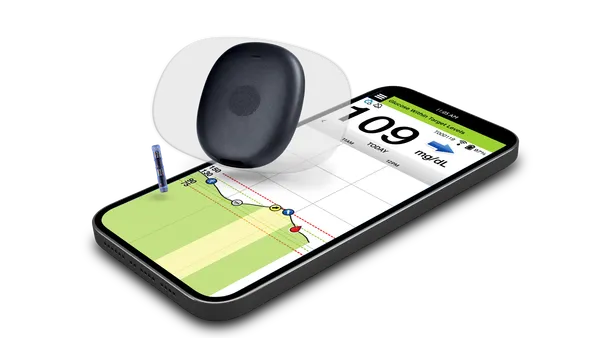
- Senseonics has received a CE mark for its one-year continuous glucose monitor Eversense 365, the company said Thursday.
- The authorization positions Senseonics to start selling the implant in Germany, Italy, Spain and Sweden in the coming months. Senseonics said the European expansion adds more than 30 million patients to its total addressable market.
- Initially, Senseonics planned to launch in Europe with Ascensia Diabetes Care. The dissolution of the deal led Senseonics to hire CGM sales reps and set up its own infrastructure for the launch.
Dive Insight:
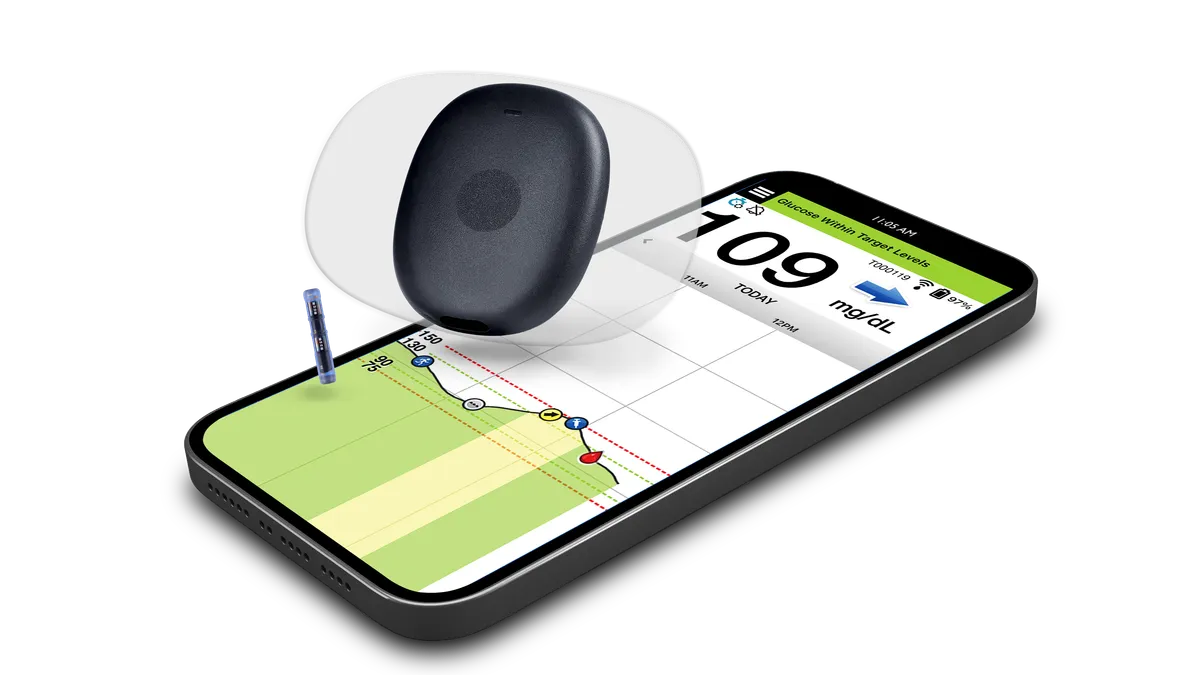
Senseonics’ CGM stands apart from Abbott’s and Dexcom’s market-leading devices. While rival devices are patches worn on the skin for around two weeks, Eversense 365 is an implant that sits under the skin and lasts for one year. Senseonics received a CE mark for an earlier version of the device in 2017 and won Food and Drug Administration approval in 2018.
Early iterations of the device had little impact on the CGM market. Senseonics bet that a longer-lasting product would sell better, leading it to develop Eversense 365 and secure FDA clearance for the one-year product in 2024. The company expects 2025 sales of $35.2 million, up 56% compared with 2024.
Eversense 365 remains a small player — CGM specialist Dexcom expects 2025 sales of $4.7 billion — but the device is driving growth at Senseonics. The company forecast 2026 sales of around $60 million, reflecting its move to retake control of commercialization from Ascensia.
The decision to end the deal with Ascensia saw Senseonics take over U.S. commercialization at the start of 2026. The European transfer is taking longer. Senseonics CFO Rick Sullivan said on an earnings call in November that the company would transition CGM-dedicated employees from Ascensia and hire its own sales force over the first half of 2026.
Senseonics initially aimed to launch Eversense 365 with Ascensia in the second half of 2025. However, with the transition underway, Sullivan said Senseonics decided to delay its launch until 2026 even though it meant missing out on some sales in 2025.
“We made that conscious decision to wait until we had our entities established and had hired our own reps to really launch the product the way we want to. That will be in the first half of the year,” Sullivan said. “Until then, it's going to be steady-state in Europe, and then we'll expect to see the similar growth as we did in the U.S. outside the U.S.”