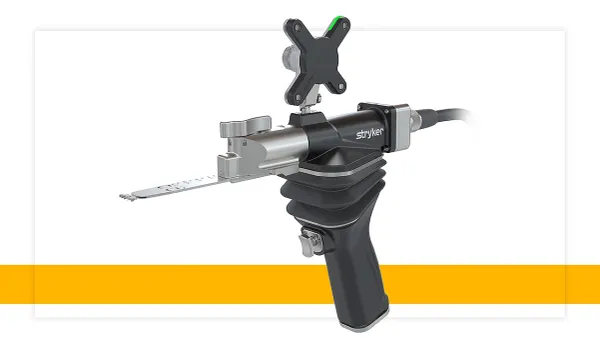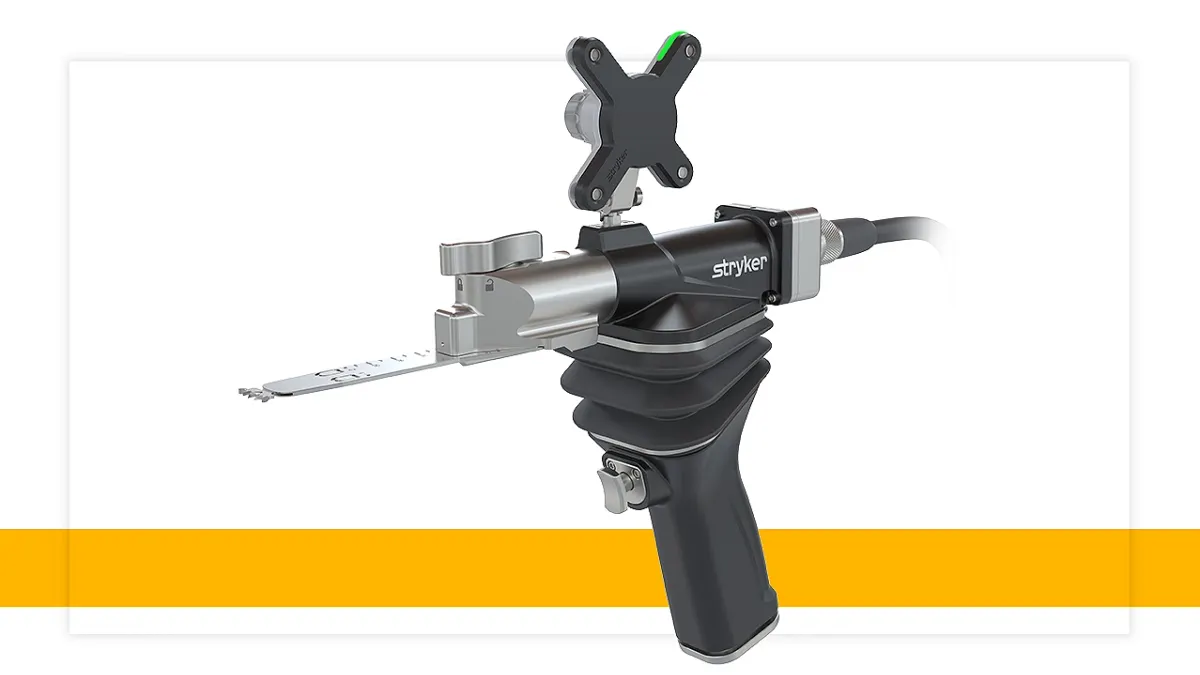
Stryker shared an update on its handheld surgical robot and other new technologies at the American Academy of Orthopaedic Surgeons meeting this week. The handheld robot, called Mako RPS, was cleared by the Food and Drug Administration last year.
After the robot was used in its first cases in January, Mako RPS is in a limited market release. Keith Evans, general manager of Stryker’s Mako and Enabling Technologies business, said the limited release is expected to continue through the first half of the year, with Stryker adding additional users in the second half of 2026.
Evans said the new robot is targeted at surgeons who do manual procedures and don’t use Stryker’s traditional Mako robotic system. The handheld robot is designed to feel similar to the saw or cutting tools surgeons use, and Evans hopes it will help convert more customers to its Triathlon knee system.
“We've been having these conversations for more than a decade, directly within Stryker, since the acquisition of Mako,” Evans said.
The traditional Mako system, which offers pre-operative planning using CT scans, has seen “tremendous growth,” he added, “but there is a portion of customers that say ‘we want consistency in the way we do things.’”
Some surgeons might prefer holding an instrument in their hand, or making decisions during a procedure instead of in advance.
Evans said Stryker has seen a lot of interest in Mako RPS from outpatient facilities, such as ambulatory surgery centers, but the device is not limited to those settings. He added that Stryker is interested in pursuing additional global markets with Mako RPS.
Stryker has been building out its robotics segment since acquiring Mako in 2013. The latest iteration of the original system, Mako 4, which uses a robotic arm to guide procedures, is indicated for knee, hip and spine procedures. Stryker also plans to bring a shoulder feature to the system late in the first half of the year, Evans said.
Stryker debuts knee component for metal sensitivities
Stryker also showcased a new femoral component for its knee replacement system at AAOS. The implant, called Triathlon Gold, has a titanium nitride coating and is intended for patients with metal sensitivities.
Lisa Kloes, general manager of Stryker’s knee business, said by 3D printing the component, Stryker is able to offer cemented or cementless options. Because Stryker wanted the base of the implant to be titanium, not chrome, the company needed to invest in new technology to be able to print the devices.
The component is in a limited market release, after receiving FDA clearance in October.