One year into the second Trump administration, leaders of the medtech industry’s largest lobbying group provided updates on key policy initiatives. AdvaMed CEO Scott Whitaker fielded questions on tariffs, which remain a question looming over the medical device sector, and shared more details on user fee negotiations in a Wednesday press conference.
Resmed CEO Mick Farrell, who became board chair of AdvaMed earlier this month, also discussed his priorities and recent digital health policies from the Food and Drug Administration.
AdvaMed wants tariff certainty
Medtech companies are seeking stability after last year’s wild swings in tariff rates. The medtech industry has also been the subject of a Section 232 investigation that started last fall, which the Trump administration has used in other industries to impose tariffs on the basis of national security.
“The president's view of tariffs and how he's using them right now might not be consistent with the model we'd like to see,” Whitaker said. He added that the lobbying group’s conversation with the Trump administration on tariffs is still ongoing, and “it is not finished yet.”
Over the last year, AdvaMed has advocated for “zero for zero” tariffs on medtech, emphasizing the devices are critical for patient care. At this point, the goal is to get to a stable policy environment on tariffs, Whitaker said.
“What's most challenging is a moving target for those of us who are global manufacturers,” he said.
MDUFA update
AdvaMed is in conversations with the FDA around the next Medical Device User Fee Amendments, or MDUFA, an agreement that sets how much the agency can raise in fees from medtech companies over a five-year period. With the current agreement set to expire in September 2027, the next MDUFA agreement must be brought before Congress ahead of time.
AdvaMed hasn’t yet shown its hand for what it hopes to get from the latest round of talks; however, Farrell said the group is seeking “more of a steady state approach.”
Whitaker added that there was a significant increase to user fees in the previous agreement, MDUFA V, to correct weaknesses in the program and to help the FDA’s device center after the COVID-19 pandemic. Now, AdvaMed is concerned with ensuring the program continues to operate efficiently and achieves all of its goals, Whitaker said, adding that negotiations have been “very constructive” so far.
One idea brought forward by the FDA in user fee discussions is to collect higher fees from firms overseas than those in the U.S. Whitaker said AdvaMed does not have a unified position on the proposal at this stage, but supports making sure the FDA has the resources it needs to be effective in markets around the world, especially where more rigorous inspection is required.
On recent wellness guidance
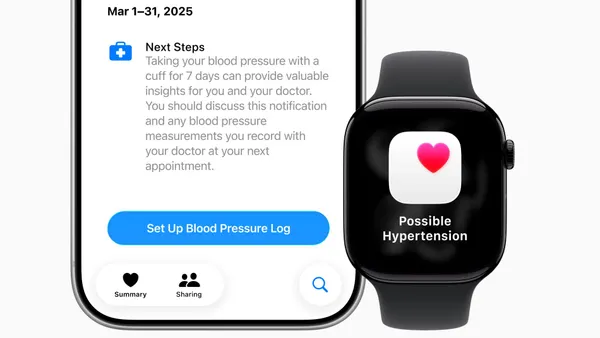
Whitaker and Farrell also talked about digital health policies put forward by the FDA, including a recent guidance that would allow a broader swath of wearable products to fall under a regulatory exemption for wellness.
Wearable devices have come into the spotlight in the last year as Health and Human Services Secretary Robert F. Kennedy Jr. has said he wants everyone in the U.S. to wear one. While readouts on diet and exercise are characterized as wellness, tools that provide a diagnosis or alert related to a specific health condition are regulated as medical devices. However, the FDA’s new guidance would open the door to blood pressure and other readings to be used for wellness, exempting them from certain regulatory requirements.
“That line between what's just information about your health and wellness and what is actually a medical decision, that needs to be a very defined line,” Farrell said. “I think the FDA is getting a little sharper on that.”
The policy changes are coming as more companies look to connect medical devices to consumer products, such as allowing people to combine activity and sleep data from wearables with their sleep apnea machine or continuous glucose monitor. Consumer technology companies, such as Apple, Microsoft and Samsung, are also members of AdvaMed.
Outside of the U.S., AdvaMed is involved in lobbying in Brussels, where many privacy and cybersecurity laws are coming out of Europe, as well as in Beijing and Tokyo, Farrell said.
“We're going to partner with the consumer tech companies to help consumers get access to information,” he added, “but they need to know what's consumer wellness and what's medical information.”