Dive Brief:
- Johnson & Johnson has led a funding round in Francis Medical, a company developing minimally invasive therapies for urological cancers.
- Francis, which disclosed the financing on Tuesday, will use the money to take its device through a premarket approval submission for the management of clinically localized prostate cancer.
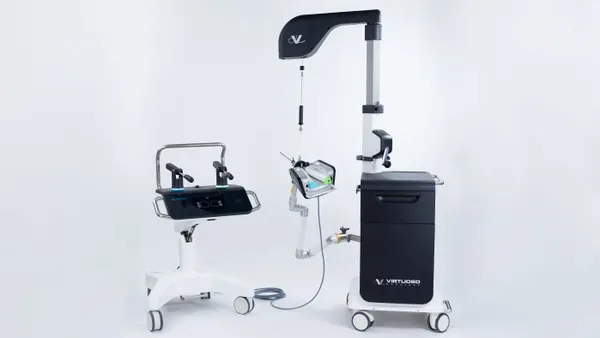
- The device delivers thermal energy to the prostate to ablate tissue while minimizing the impact on surrounding structures associated with urinary and sexual function.
Dive Insight:
Francis’ Vanquish system uses water vapor to ablate tissue. While Boston Scientific’s Rezūm uses water vapor to treat benign prostatic hyperplasia, Francis aims to apply the technique to prostate cancer. The expansion of the approach to cancer is supported by the development of a deployable, variable-distance needle and real-time ultrasound monitoring.
J&J is funding Vanquish development via its corporate venture capital organization, Johnson & Johnson Innovation. Francis has raised enough cash to scale its commercial infrastructure, expand market-access initiatives and strengthen physician training and education programs.
Physicians are already using Vanquish commercially. The Food and Drug Administration granted 510(k) clearance to the system for prostate tissue ablation in December, and a physician performed the first commercial procedure using the system in February. Francis brought the device to market using the proceeds of an $80 million series C financing round that it raised last year.
The FDA has yet to assess Vanquish for the treatment of any disease, including prostate cancer. Francis’ planned PMA could support use in prostate cancer. The company is running a clinical trial in 235 people with intermediate-risk, localized prostate cancer in the U.S.
In June, Francis published data on the first 110 patients enrolled in the trial. Six months after treatment, biopsies found only benign tissue in 75% of patients. Biopsies found benign tissue or low-risk prostate cancer in 91% of patients. Patients’ urinary and sexual function declined initially but generally improved toward baseline levels 12 months after treatment. Francis will monitor patients for five years.