Dive Brief:
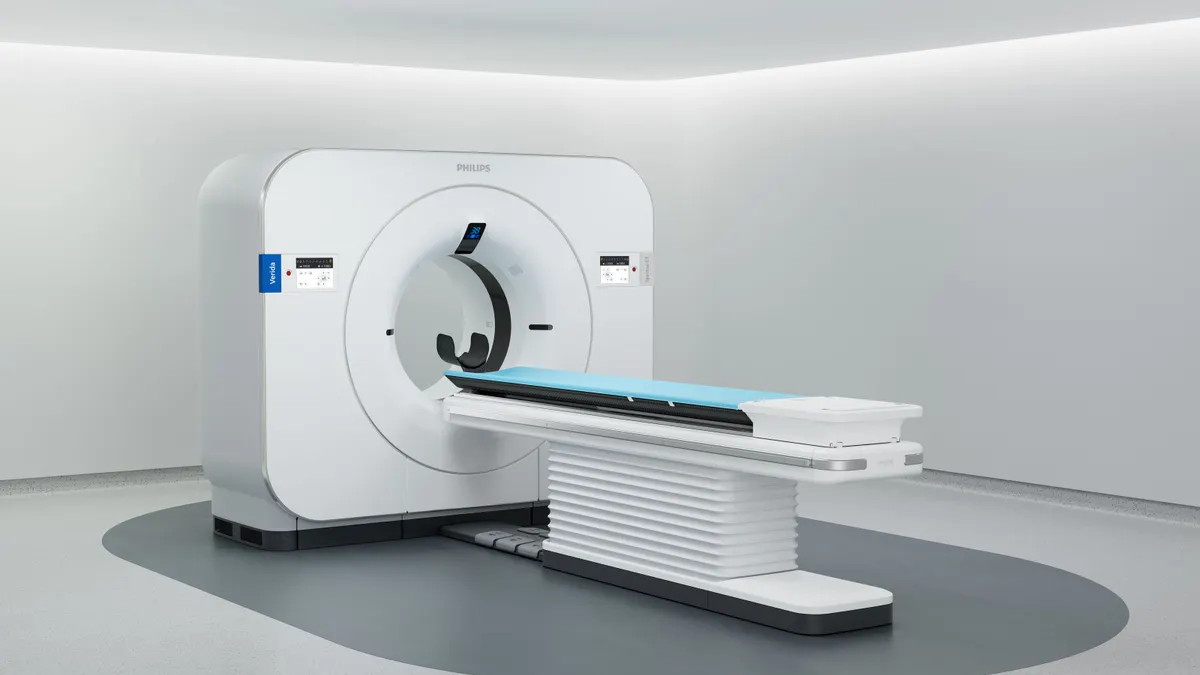
- Philips has received Food and Drug Administration clearance for an artificial intelligence-enabled CT system.
- The 510(k) clearance, which Philips disclosed Thursday, covers a Verida device that the company claims reduces image noise by 80% and reconstructs scans twice as fast as its predecessor.
- Jie Xue, chief business leader for precision diagnosis at Philips, recently said Verida’s throughput sets it apart from photon-counting CT technology. GE HealthCare and Siemens Healthineers sell photon-counting devices.
Dive Insight:
Philips’ latest product builds on its earlier spectral CT device. By measuring how tissues absorb different X-ray energy levels, spectral CT systems differentiate between materials that look the same on standard CT images. Philips’ newly cleared product combines spectral CT with AI.
The updated CT system reconstructs 145 images per second, allowing healthcare professionals to view exams within 30 seconds. Philips said the system is twice as fast as its predecessor and, when installed at a facility with a 16-hour working day, enables radiology centers to perform up to 270 exams a day.
At an investor event in February, Xue said AI drove an 80% reduction in dose and image noise and made the system better at detecting subtle differences in tissue. Philips aims to leverage those improvements to increase its share of the premium CT device market through 2028. Following the system’s CE mark last year, Xue said the first installation was underway at a site in Madrid in February.
GE HealthCare and Siemens Healthineers are also targeting the premium CT space. Siemens Healthineers received 510(k) clearance for a photon-counting CT device in 2021. GE HealthCare secured clearance for a rival photon-counting device in March.
Xue said photon counting is a powerful CT technology, but it is not ready for the high-throughput clinical environments Philips is targeting with Verida. The Philips executive said the company will enter the spectral photon counting market when the technology is ready.
Verida costs 1 million euros to 2 million euros, depending on the market, Xue said. Taking 1.5 million euros as the midpoint price for Verida, Xue said photon counting “doubles that.” The price difference and claimed speed advantages led Xue to claim Philips has the right solution for healthcare professionals who want to “go straight to the diagnostic answer on their workstations and at a cost competitive point.”