Abbott lowered its earnings forecast for the year following its $21 billion purchase of Exact Sciences.
Abbott now expects adjusted earnings per share of $5.38 to $5.58 for 2026, down from its previous forecast of $5.55 to $5.80. The update includes 20 cents of dilution related to the Exact acquisition.
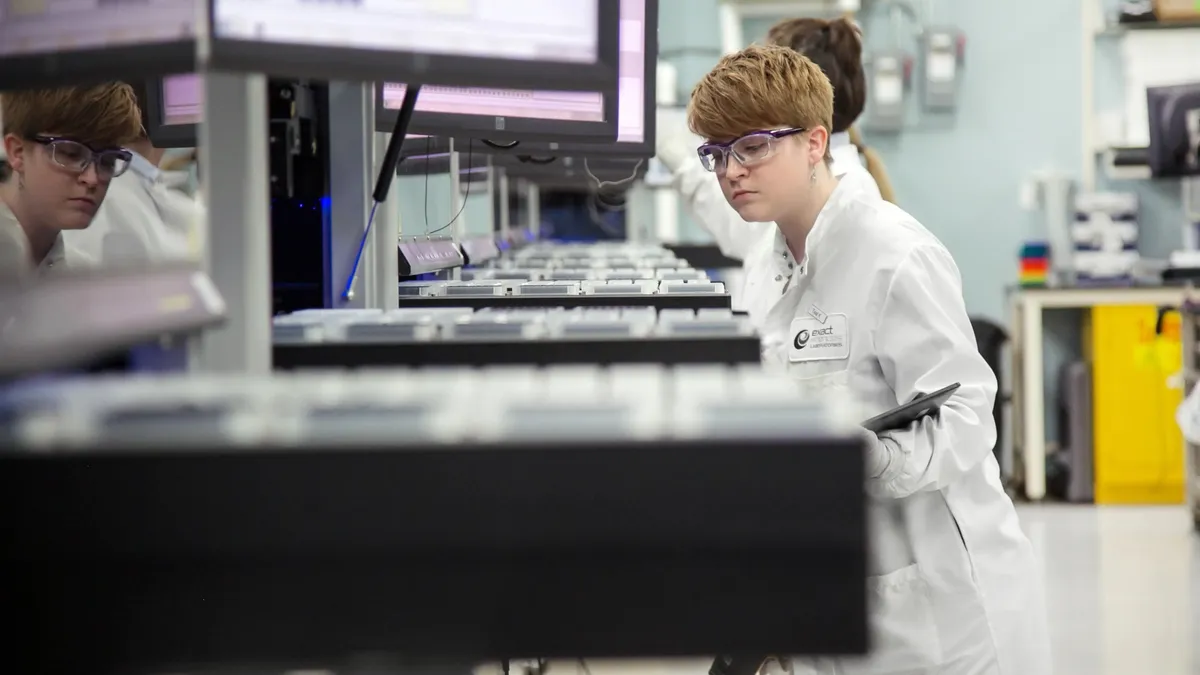
Abbott acquired the cancer diagnostics firm in March, giving the company a presence in one of the fastest growing areas of healthcare, CEO Robert Ford said in a Thursday earnings call. Exact makes the Cologuard screening test for colorectal cancer, a part of the business that Abbott expects to continue to grow. The recommended screening age for colorectal cancer was lowered from 50 to 45, and with an average wait time for a colonoscopy of three to nine months, demand for Cologuard is strong, Ford said.
The CEO is also interested in Exact’s other tests for cancer therapy selection and detecting minimal residual disease.
Abbott promoted Jake Orville to senior vice president of cancer diagnostics, reporting directly to the CEO. Orville previously led Exact’s screening business with Cologuard.
“I couldn't have asked for a better integration,” Ford said. “Culturally, I think both companies are very compatible; very focused on the patient and on innovation and driving growth.”
Abbott expects Exact to add about $3 billion of incremental sales in 2026, Ford said.
Other businesses miss forecasts
Abbott’s shares declined 4% to $97.58 Thursday morning as other parts of the business fell behind analysts’ expectations.
The first quarter results “disappointed across major segments of MedTech,” including diabetes, structural heart and diagnostics, RBC Capital Markets analyst Shagun Singh wrote in a research note Thursday.
While diabetes care sales grew by more than 7% to $2.08 billion, that fell short of analysts’ expectations of 11.5% organic growth, Singh wrote.
Ford addressed the concerns, saying the diabetes business goes through periods of modest growth and strong acceleration, adding that he expects expanded reimbursement and a planned dual-analyte system to drive future growth. Abbott expects to receive Food and Drug Administration authorization for the glucose-ketone sensor in the second half of the year.