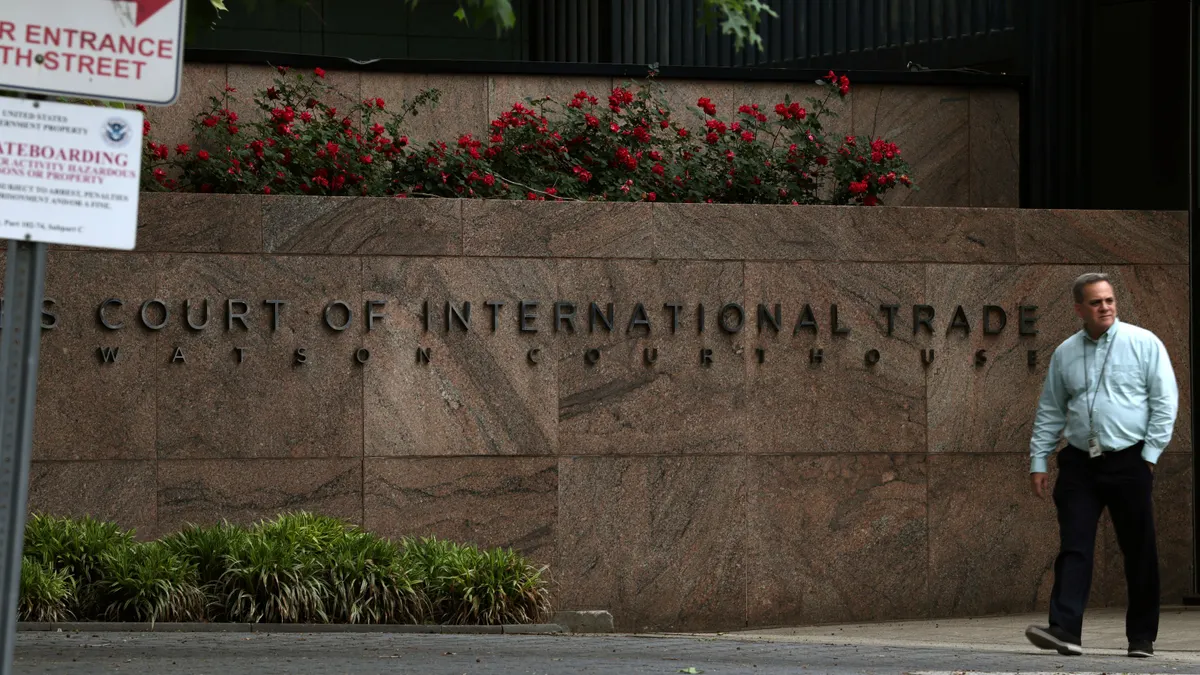

The U.S. Court of International Trade has ruled that a temporary 10% global tariff President Donald Trump installed earlier this year is illegal.
In a slip opinion issued Thursday, the court said that the proclamation Trump signed to enact the levy “is invalid” and that the tariffs themselves are “unauthorized by law.”
The decision came in a case before the court that combined separate lawsuits filed against tariffs Trump installed in February under Section 122 of the Trade Act of 1974. In Thursday’s ruling, the court said the administration’s rationale for implementing the levies did not meet Section 122’s criteria, calling it an “expansive reading of the statute.”
“The Government’s preferred interpretation of the statute must therefore be disfavored,” the court said.
“In other words, the court appears increasingly uninterested in turning every old trade statute into a universal tariff bazooka,” Pete Mento, director of global trade advisory services at Baker Tilly, said in a LinkedIn post.
While the court ruled against the tariffs, it stopped short of issuing a nationwide stay on their collection, instead granting injunctive relief to two importers and the state of Washington. However, after the federal government filed an appeal on Friday, the court this week stayed the injunction pending the outcome of the motion.
The importing companies, spice brand Burlap and Barrel and toy company Basic Fun, sued the Trump administration in March over the global tariff. Earlier the same month, a group of more than 20 states also filed suit seeking the removal of the duties.
In Thursday’s ruling, the court stated that Burlap and Barrel and Basic Fun qualified for injunctive relief because they provided evidence that they had either begun paying the tariffs or would be forced to do so imminently. In their suit, the two companies both affirmed they had shipments scheduled to arrive in the U.S. during the 150 days the tariffs were set to be in place.
However, the cohort of states — except for one — was unable to provide such evidence, the court said. Only the State of Washington was granted relief since it filed a complaint on behalf of an affected importer, the University of Washington. In its complaint, the public university stated that it purchases goods from overseas that have previously been subject to tariffs and expects to do so again during the timeframe for the Section 122 duties, according to the ruling.
“Importer Plaintiffs have paid, and, absent injunctive relief, will continue to pay Section 122 duties that the court has held to be unlawful,” the court said, adding “whether the court has authority to issue universal injunctive relief is, at present, an open question.”
Thursday’s decision is another legal blow to Trump’s tariff regime. In February, the Supreme Court invalidated the global and reciprocal tariffs Trump enacted under the International Emergency Economic Powers Act last year. Following that ruling, Customs and Border Protection rolled out Consolidated Administration and Processing of Entries, or CAPE, a dedicated portal to deliver refunds for the removed levies.
With the Court of International Trade now invalidating Section 122 tariffs, “it raises another massive potential refund and reliquidation issue for importers already drowning in CAPE submissions, protests, offsets, and reconciliation problems,” Mento said. However, it remains unclear what comes next for the levies after Thursday’s ruling.
“Of course, this is almost certainly headed to appeal,” Mento said prior to Friday’s appeal. “Nothing in trade law is ever simple.”
Editor's note: This story was updated following an appeal to the ruling.