Dive Brief:
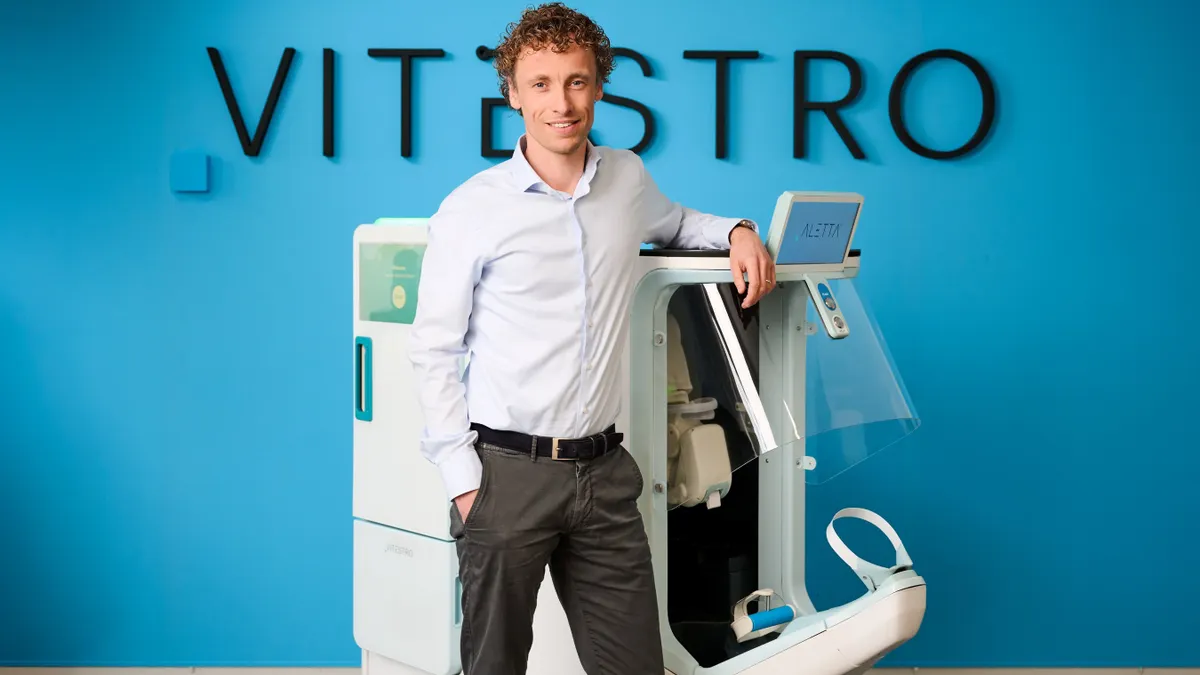
- The Food and Drug Administration said Wednesday it has authorized Vitestro’s first-of-its-kind robotic blood draw device.
- Vitestro designed the device, Aletta, to draw blood from a patient’s arm without the hands-on involvement of an operator.
- One phlebotomist can oversee up to three devices, leading the FDA to predict that Aletta may help address the shortage of people trained to take blood samples in the U.S.
Dive Insight:
Using imaging, robotics and artificial intelligence, Aletta finds veins, guides needle insertion and collects blood samples. The device uses multiple forms of ultrasound to find veins and differentiate the vessels from arteries. Aletta handles each step in the process, from applying a tourniquet to covering the needle puncture site with a bandage.
The supervising phlebotomist’s role is limited to confirming that collection tubes are filled in the correct order, verifying that all tubes are adequately full following the procedure and responding to alerts issued by the device. A trained professional has to clean Aletta between patients.
Vitestro raised $70 million in March to bring the device to the U.S. market. The venture capital wing of Labcorp, which employs phlebotomists to take blood samples for testing at its laboratories, participated in the financing round, as did Mayo Clinic, Sutter Health and Intuitive co-founder Fred Moll.
Aletta received a CE mark in 2024, allowing Vitestro to start an initially limited market release in Europe. Vitestro put broader market adoption, beginning in Europe and progressing toward the U.S. market, on its roadmap after raising the $70 million in Series B funding. The company’s planned uses for the money included manufacturing scale-up, clinical expansion and commercial infrastructure development.
The FDA’s de novo authorization of Aletta included special controls to support the development of other robotic blood draw devices. The controls define the performance and clinical testing requirements, as well as the labeling conditions, that companies need to meet to bring robotic blood draw devices to the U.S. market via the 510(k) pathway.
Vitestro is developing a next-generation device designed to enable deeper integration into high-volume clinical workflows.