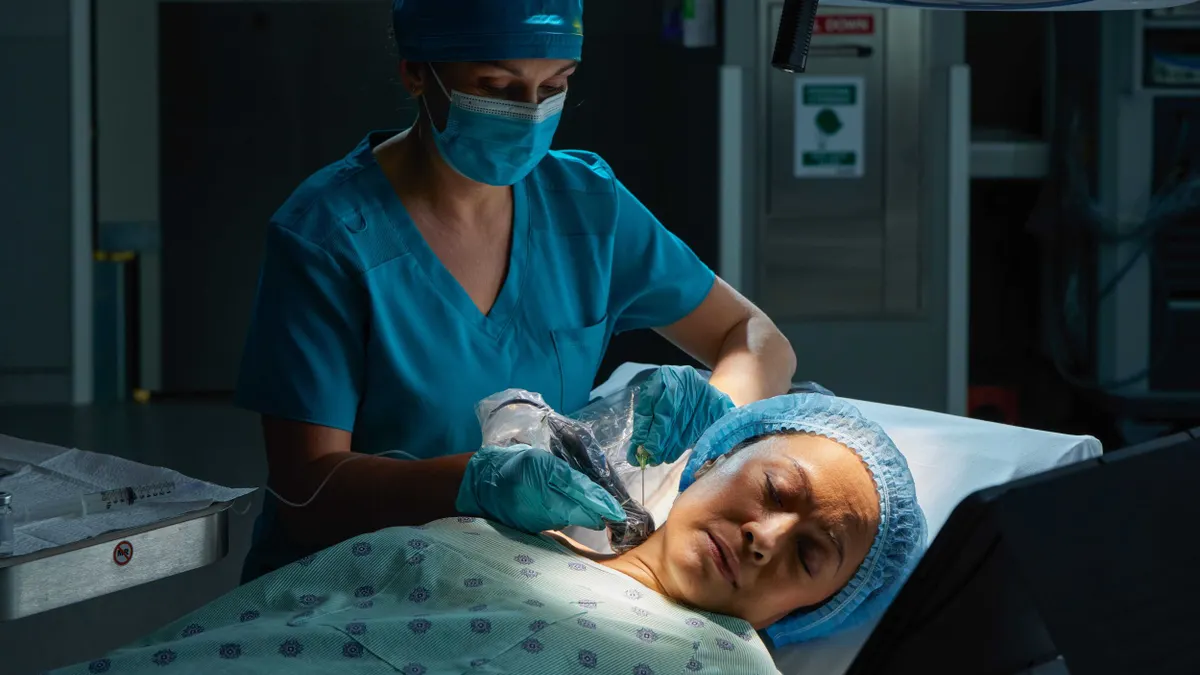
Butterfly Network, a company that makes a point-of-care ultrasound device, hopes to make the technology widely available with its chip-based approach.
CEO Joe DeVivo, who joined the Burlington, Massachusetts-based company in 2023, said in an interview with MedTech Dive that his goal is to make ultrasound low cost, mobile and easy to use.
“Not everyone has a chance to go into the hospital and not everyone has a chance to get [an ultrasound] scheduled,” said DeVivo, who was previously executive chairman of ultrasound startup Caption Health, which was acquired by GE HealthCare in 2023.
About six months ago, DeVivo took his son to an emergency room after his pediatrician flagged a potential concern. They waited for three hours to get an ultrasound, which ruled out the doctor’s worries.
“If that pediatrician had ultrasound,” DeVivo said, “we wouldn't have even gone.”
Ultrasound, a form of imaging that uses high-frequency sound waves to view inside the body, can be used to diagnose heart failure, monitor fetal development during pregnancy and guide needles during a procedure.
Butterfly’s device differs from traditional, cart-based ultrasound machines, which use several acoustic lenses that must be changed out depending on the type of image the user is trying to get.
Butterfly’s semiconductor technology allows users to switch between pre-programmed settings for different images while still using the same probe. The company’s chip has 9,000 tiny sensors that vibrate sound, DeVivo said. Higher frequencies allow clinicians to view structures closer to the surface, while lower frequencies are better for viewing deeper inside the body, for structures such as the heart.
Traditional machines cost $30,000 to $40,000, or can be upwards of $200,000 for more specialized systems, DeVivo said. Butterfly’s handheld device, which includes a probe that can be plugged into a cell phone, costs about $4,000. The company also charges an annual membership for certain imaging modes and artificial intelligence features.
Butterfly’s competitors include other point-of-care ultrasound systems, such as GE HealthCare’s Vscan Air, Philips’ Lumify and Clarius’ handheld devices.
DeVivo said Butterfly has more than 150,000 devices distributed around the world. The portable ultrasounds have been used in major hospital systems, rural clinics and by medics in Ukraine. The devices have also been sent to the International Space Station and featured in medical drama “The Pitt.”
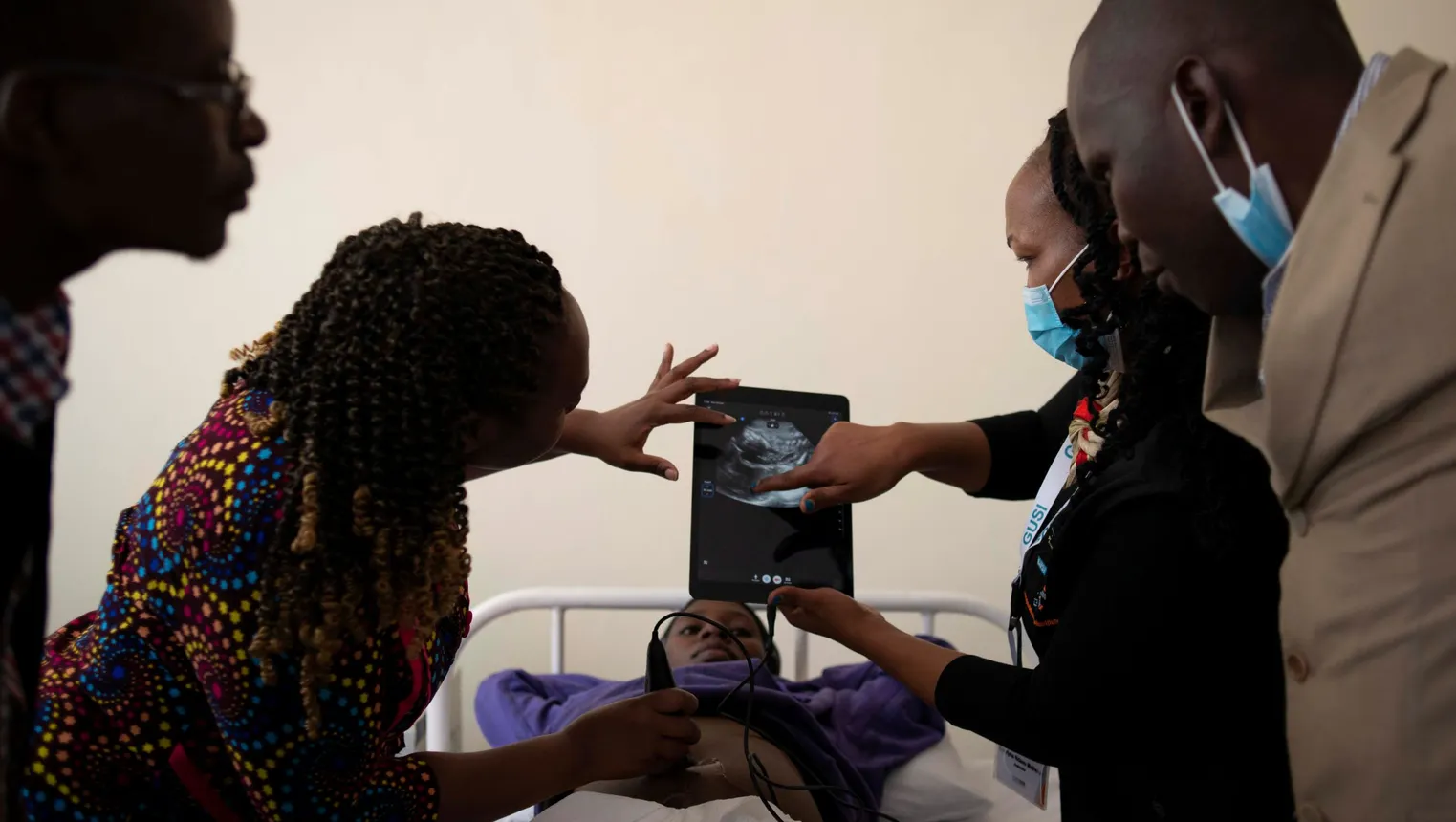
A personal experience inspired Butterfly founder Jonathan Rothberg to start the company. Rothberg took the train to Boston for his daughter’s imaging appointment, and thought, wouldn’t it be great if everybody could have ultrasound technology at home?
“I only want to do something if it will help somebody I love,” Rothberg said in an interview. “And the vision was not only to put it on a chip, but to pair it with AI so people could have it at home.”
Two thirds of the world’s population has no access to imaging, Rothberg said. His dream is for that to no longer be the case.
Butterfly launched its first device in 2018 at just $2,000, Rothberg said. With the company’s chip-based technology, he sees the potential to use it in other form factors, such as patches or as part of an endoscope.
Butterfly went public in 2021 through a merger with a special purpose acquisition company that valued the ultrasound firm at $1.5 billion. The company’s shares have declined by about half since its IPO was announced. Butterfly’s market capitalization was $1.37 billion as of April 27.
Last year, the company reported revenue of $97.6 million and a net loss of $77.1 million.
Butterfly is looking to new features and partnerships around its technology for future growth. In November, it struck a co-development and licensing agreement with generative AI firm Midjourney that included a one-time payment of $15 million and a $10 million annual licensing fee.
Last month, Butterfly received FDA clearance for an AI tool for estimating gestational age. The company has also started offering third-party applications, including an FDA cleared tool to help clinicians get diagnostic quality heart scans.
DeVivo expects these AI applications will help open ultrasound to a wider group of users.
“We think that is what's going to liberate it from the enthusiast who knows how to do ultrasound,” DeVivo said, “to everybody being able to use it.”