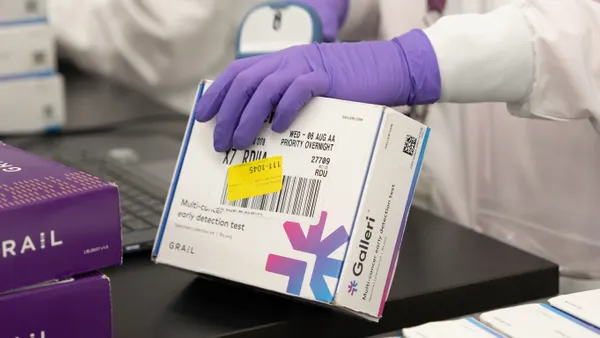
Grail is pushing ahead with plans to expand use of its Galleri multi-cancer early detection test even though its key clinical trial failed to meet the primary endpoint.
At the American Society of Clinical Oncology’s annual meeting this weekend, the company presented full results from the NHS-Galleri trial that showed no significant reduction in Stage III and IV cancers. The study evaluated annual screening with Galleri in England’s National Health Service in 142,250 asymptomatic participants intended to support population-scale use in the country.
The results affirmed a first look at the data, released in February, that raised doubts about the company’s ability to achieve Food and Drug Administration approval and Medicare coverage for the test. Grail’s shares lost about half their value when the initial findings were released.
Grail executives, however, emphasized encouraging signals from the NHS-Galleri study, notably a more than 20% reduction in Stage IV diagnoses in a pre-specified group of 12 cancers and a 16% increase in cancer detection at Stages I and II. A second trial called PATHFINDER 2, also presented at the ASCO meeting, showed 60% of diagnosed cancers were detected by screening.
CEO-elect Joshua Ofman said the package of evidence submitted to the FDA includes the first year of the NHS-Galleri trial and all of the PATHFINDER 2 data. The company doesn’t plan to change any of its materials before the FDA’s decision. The study results demonstrate Galleri’s clinical benefits for population health, Ofman told analysts on a call.
“The NHS-Galleri study is the first time any MCED has demonstrated the ability to generate a stage shift in how cancers are detected,” Ofman said. “This is truly a historic moment.”
The company submitted its premarket approval application for Galleri to the FDA in February. Galleri is available in the U.S. as a laboratory developed test.
ASCO comments on Galleri
ASCO, in a statement, said early testing with Galleri may shift the stage at which cancer is found, reducing detection at stage IV, but more follow-up is needed before the test is incorporated into screening guidelines.
"While the Galleri-NHS study results show some encouraging trends toward tumor downstaging, it is important to recognize that the trial did not statistically reduce late-stage cancers by its predefined primary endpoint,” said Julie Gralow, ASCO’s chief medical officer. “Nevertheless, these findings still offer genuine hope for deadly malignancies that currently lack screening options, such as ovarian and pancreatic cancer.”
FDA approval and Medicare coverage remain the two most important catalysts for the company going forward, Canaccord Genuity analyst Kyle Mikson told clients in a note. The analyst expects the FDA to convene an advisory committee meeting on Galleri “given the novel nature of the test.”
TD Cowen analyst Dan Brennan said an advisory panel could be held in the fall, with an FDA decision possible later this year or in early 2027. If the FDA approves the test, the Centers for Medicare and Medicaid Services could issue a national coverage determination for Medicare nine to 12 months later.