Dive Brief:
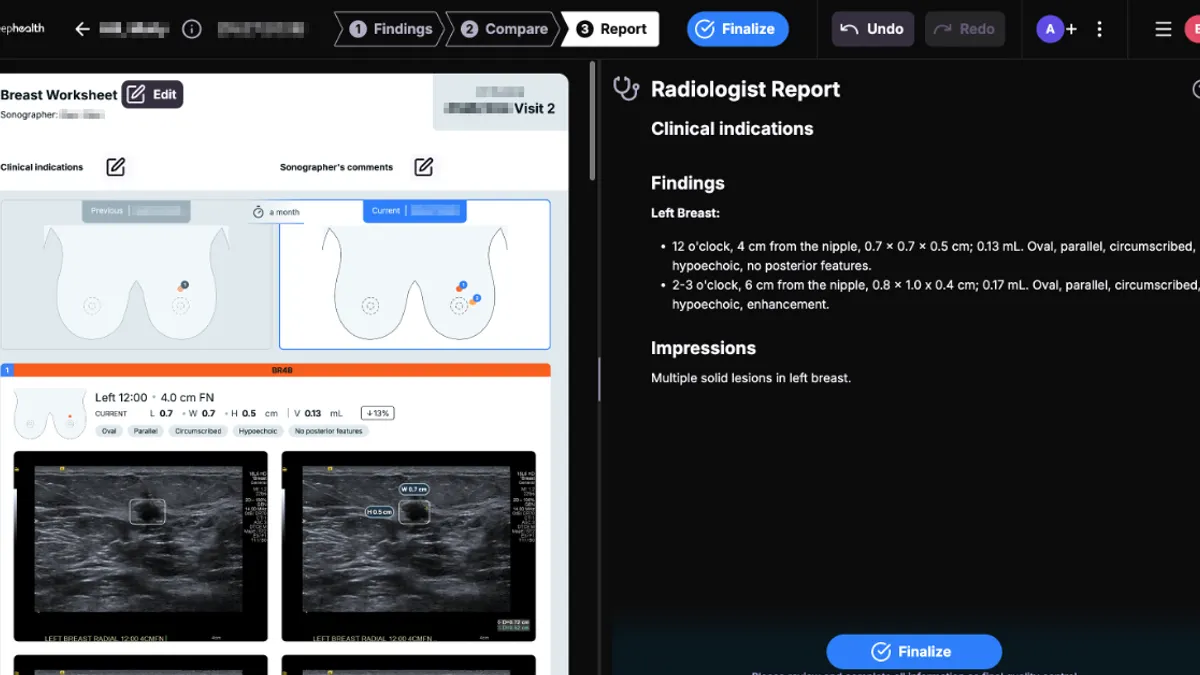
- DeepHealth last week received the Food and Drug Administration’s 510(k) clearance for an artificial intelligence tool that reads breast ultrasound images and generates reports.
- The feature can help clinicians localize suspicious soft tissue lesions; characterize details about the lesion such as its shape, orientation, and margin; and generate a report with key findings and impressions. Radiologists still have control of the final assessment.
- DeepHealth’s parent company, RadNet, plans to offer the tool across its network of imaging centers by the end of the year.
Dive Insight:
DeepHealth said the tool can help radiologists save time and improve breast cancer detection. In study data submitted to the FDA as part of the clearance, the company found the breast ultrasound feature improved sensitivity for breast cancer detection by 8%. DeepHealth also found that its tool can reduce radiologist interpretation times by 37%.
The company studied the feature with 16 radiologists at imaging centers and hospitals. The full results have not yet been published.
The technology is part of DeepHealth’s breast suite, which includes reporting and analysis tools for mammography. Mammograms are typically used as a first line screening tool for breast cancer, while ultrasounds may be used as additional screening for people who have an unusual finding or dense breast tissue.
RadNet acquired the feature when it bought AI ultrasound firm See-Mode Technologies in 2025. The company was integrated with DeepHealth, RadNet’s digital health subsidiary.
With the FDA clearance, the company plans to sell the breast ultrasound tool to customers who can pursue reimbursement under an existing CPT code for quantitative ultrasound tissue characterization. RadNet estimated that more than 700,000 breast ultrasound studies per year may be eligible for reimbursement across its network. The company has more than 400 outpatient imaging centers.
DeepHealth’s FDA clearance comes as the agency evaluates other devices that combine image analysis with report drafting. Aidoc and Cognita both have received the FDA’s breakthrough device designation for tools intended to both read chest X-rays and generate draft reports for radiologist review.