Dive Brief:
- Johnson & Johnson has won Food and Drug Administration approval for a catheter that delivers radiofrequency and pulsed field energy to treat atrial fibrillation.
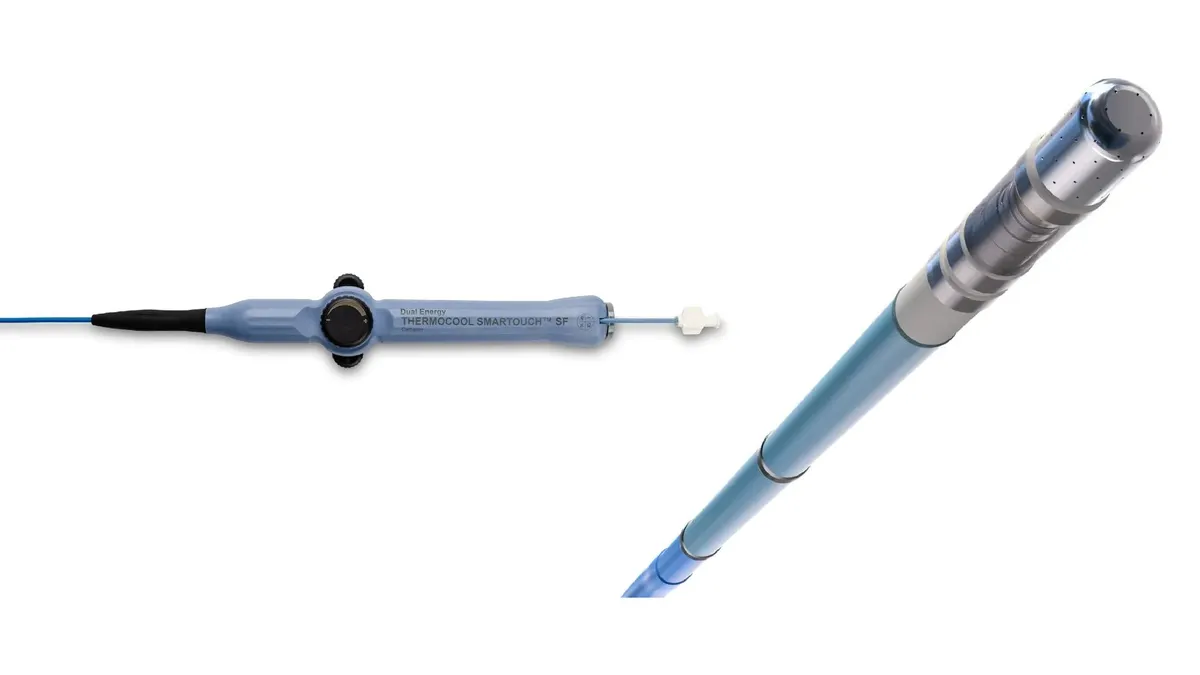
- The approval, which J&J disclosed Wednesday, covers the Dual Energy Thermocool Smarttouch SF Platform. J&J already had approval for a single, radiofrequency energy version of the device.
- Integrated into the company’s Carto mapping system, the dual-energy catheter is part of J&J’s push to leverage its electrophysiology strength to reverse market share losses triggered by PFA.
Dive Insight:
Boston Scientific and Medtronic beat J&J to the PFA market. Shortly after J&J launched its Varipulse PFA device, it temporarily paused all U.S. cases to investigate four reported neurovascular events.
As 2026 began, J&J CEO Joaquin Duato said the company was “gaining back share in PFA” and predicted that it would launch “a new catheter every year through the end of the decade.”
J&J received a CE mark for the dual-energy Thermocool catheter in January 2025 and began its first cases in Europe later that year. The company continues “to receive strong feedback” for the dual-energy device in Europe, Duato said on J&J’s first-quarter earnings call in April.
Talking to J&J’s Michael Bodner at an event in May, RBC Capital Markets analyst Shagun Singh said her channel checks indicated that dual-energy catheters are used in about 20% to 30% of cases. The device could help J&J “regain more share in the complicated end of the procedure spectrum,” Singh said, citing key opinion leaders.
Bodner, company group chair, electrophysiology and neurovascular at J&J, said the dual-energy device is based on the most widely used radiofrequency catheter globally. The catheter is what physicians train on and are most used to, Bodner said.
Adding the ability to toggle between radiofrequency and pulsed field energy gives physicians “a lot of versatility, depending on the complexity of the patient,” Bodner said. The J&J executive outlined how ablations near anatomy such as the coronary arteries pose challenges that make access to different energy valuable.