Dive Brief:
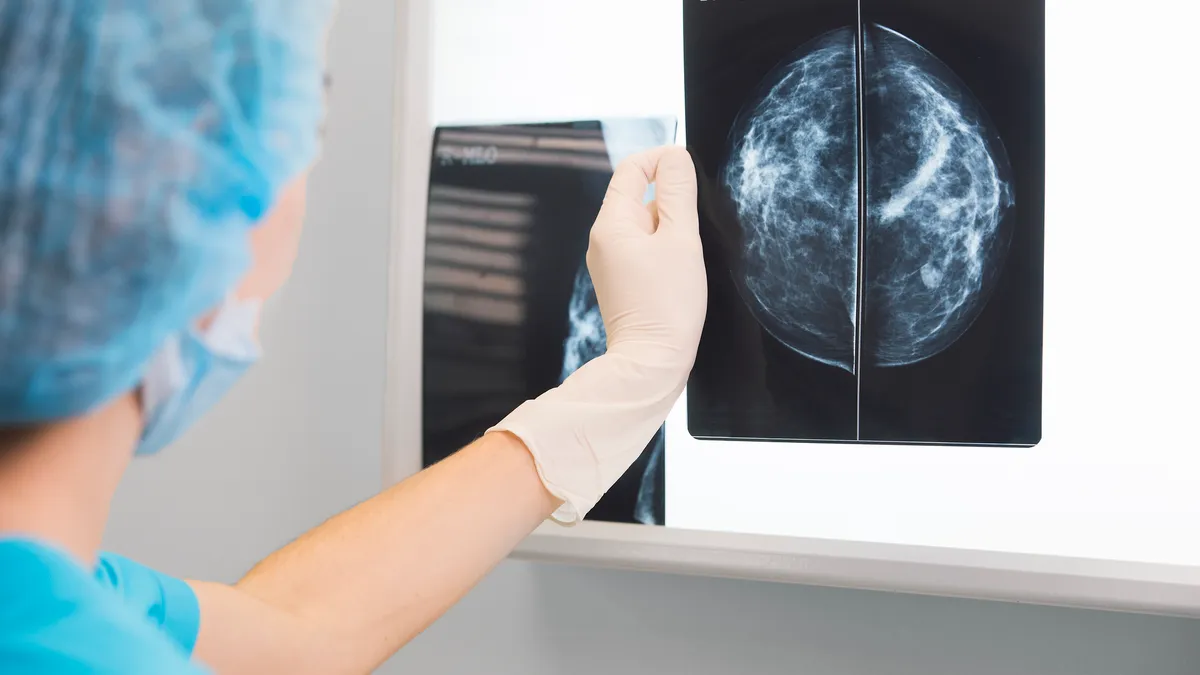
- Vara received Europe’s first authorization for an artificial intelligence-enabled system that can autonomously screen mammograms without radiologist review.
- The tool allows examinations the system classifies as normal to be reported by AI without being read by a radiologist. Every other result must be read by at least one radiologist.
- Berlin-based Vara said a safety system it has developed to supervise its AI models allowed it to receive the designation. The system helped it meet the continuous human oversight requirement for high-risk AI systems under the European Union AI Act.
Dive Insight:
In Europe, the standard of care for breast cancer screening is for two radiologists to interpret a single mammogram.
Vara said its autonomous triage feature is intended for population screening amid a shrinking radiologist workforce. The system was authorized as a Class IIb device, indicating medium to high risk, under the EU’s Medical Device Regulation.
Vara said the autonomous triage feature is now available for screening programs across Europe, with the rollout following countries’ guidelines and readiness. More than half of Germany's organized breast screening program runs on Vara, at more than 250,000 screenings per month.
The company is also making the safety system, which it has dubbed ATMON (Autonomous-Triage Monitoring), available for new and existing customers. They can use it even if they don’t switch to fully autonomous triage, the company said.
ATMON monitors changes in mammography hardware, system health and daily performance. If those values fall outside of set limits, the system can revert a site to full radiologist reading.
“... Even the best AI model's performance can shift once it operates outside the controlled conditions of a study," Vara CEO and co-founder Jonas Muff said in a statement. "For AI to deliver its positive impact on patient outcomes, we need to notice when this happens.”
A large study of Vara’s system, funded by the company, was published in Nature Medicine last year. The study compared a standard double reading by radiologists with AI-supported double reading, finding a higher breast cancer detection rate among the AI-supported readings. The study ran from 2021 to 2023 and included more than 460,000 women, a little over half of whom received AI-supported screenings.