Dive Brief:
- Johnson & Johnson said Tuesday that a study evaluating the investigational Ottava robotic system in gastric bypass surgery met its safety and efficacy endpoints through 30 days. The average weight loss in that time frame was 30 pounds.
- Results from the 30-patient study were among the pre-clinical evidence included in J&J’s submission to the Food and Drug Administration, announced in January, for de novo classification of the robot in multiple procedures in the upper abdomen.
- All procedures in the prospective, multicenter study were completed robotically on Ottava without conversion to a non-robotic approach, the company said. There were no adverse events related to the device.
Dive Insight:
Ottava will compete with Intuitive Surgical’s da Vinci and a growing number of new robots coming to market. J&J expects the system, which could launch in the U.S. by the end of the year, to be an important catalyst for faster growth in the company’s medtech business when it gains FDA authorization, Tim Schmid, worldwide chairman of medtech, told investors in April.
J&J is targeting an indication covering several procedures in general surgery, including gastric bypass, gastric sleeve, small bowel resection and hiatal hernia repair. An investigational device exemption trial for inguinal hernia repair is also underway.
The newly released data evaluated Ottava in Roux-en-Y gastric bypass, a type of weight-loss surgery that creates a small pouch from the stomach to reroute food to the small intestine. The operation is technically demanding and requires steps that typically span multiple abdominal quadrants, J&J said.
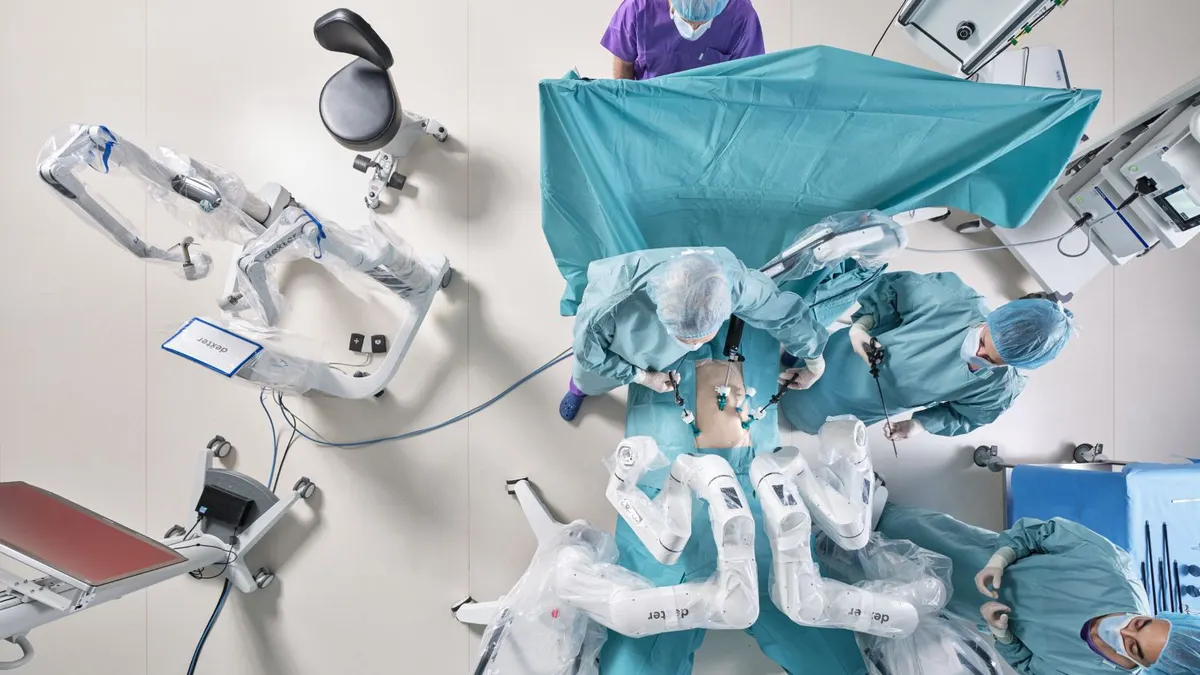
Ottava incorporates four robotic arms into a standard size surgical table, removing the need for a separate boom or carts. In the gastric bypass study, the robot was installed in six hospitals with operating rooms ranging in size from 243 to 694 square feet. Some of the rooms had not been used for robotic surgery before due to space constraints, J&J said.
The system can allow more hospital operating rooms to accommodate robotics, according to J&J.
“These results demonstrate that the novel architecture can integrate into existing infrastructure and remove practical barriers to broader adoption," Peter Schulam, J&J’s chief scientific officer for medtech, said in a statement.
The data were presented in an abstract at the American Society for Metabolic and Bariatric Surgery’s annual meeting in San Antonio, Texas.