Study results supporting Edwards Lifesciences’ transcatheter aortic valve replacement in patients with less severe disease were a highlight of the Transcatheter Cardiovascular Therapeutics conference.
Also notable were findings on Medtronic’s renal denervation system in a broader patient population and the performance of Abbott’s Amulet 360 left atrial appendage closure device one year after implant.
The TCT conference, which wrapped up in San Diego this week, is the Cardiovascular Research Foundation’s annual scientific symposium. Here are details on three key studies to know from the conference:
1. Edwards’ TAVR superior in moderate disease
Edwards Lifesciences’ TAVR device met its primary endpoints in a study of patients with moderate aortic stenosis and at-risk features. At the meeting, the results received a “very strong round of applause” from physicians, J.P. Morgan analysts wrote to clients.
TAVR proved superior to clinical surveillance on the composite effectiveness endpoint of death or heart failure events at two years. Guidelines call for clinical surveillance, including echocardiogram, in moderate disease. The TAVR group also saw no mortality or disabling stroke through 30 days.
The PROGRESS study data provide “unequivocal validation” of TAVR’s benefit as a treatment option for moderate AS patients, Dan Lippis, Edwards’ corporate vice president of TAVR, said in an interview before the presentation. “This should give physicians and patients great comfort and great confidence in that treatment strategy,” Lippis said.
There are one to two times as many people with moderate AS as there are with severe AS, said Lippis. About half of moderate AS patients have at-risk features such as cardiac damage or dysfunction.
Published in The New England Journal of Medicine, the study followed 744 patients whose average age was 78 years. The trial estimated an endpoint event in 16.7% of the TAVR patients and 23.9% of the surveillance group at two years. On all-cause mortality alone, the findings showed 8.4% of TAVR patients died, compared with 7.3% in the surveillance group.
The higher number of deaths in the TAVR group may have caused initial concern among investors, said Truist Securities analysts, but they thought doctors would not view the data negatively in the context of the overall results.
J.P. Morgan’s analysts predicted TAVR will become the standard of care for elderly patients with moderate AS and co-morbidities, while Stifel analysts said the study “could be a catalyst that changes when aortic-valve disease is treated and potentially revolutionizes the market.”
2. Medtronic’s renal denervation works in broader population
Medtronic’s Symplicity Spyral renal denervation catheter showed statistically significant blood pressure reductions at six months in a post-approval study required by the Food and Drug Administration.
The prospective, single-arm study reaffirmed the safety and efficacy of renal denervation in a broader patient population with uncontrolled hypertension. Among 594 U.S. patients treated in the SPYRAL AFFIRM study, 45% were women, 27% were Black, 11% were Hispanic and 19% had Type 2 diabetes.
The trial met its primary endpoint, with blood pressure reductions in a clinical setting exceeding the predefined performance goal. Nearly nine in 10 patients had an office systolic blood pressure reduction of at least 10 mm Hg, a home systolic reduction of at least 5 mm Hg and a reduction of at least one antihypertensive medication after a renal denervation procedure, data published in the journal Circulation: Cardiovascular Interventions showed.
Symplicity Spyral won Food and Drug Administration approval in late 2023. Along with releasing study findings Tuesday, Medtronic said the FDA approved a label update to the renal denervation procedure to include additional clinical data for informing treatment decisions.
3. Abbott’s redesigned Amulet LAA implant safe, effective
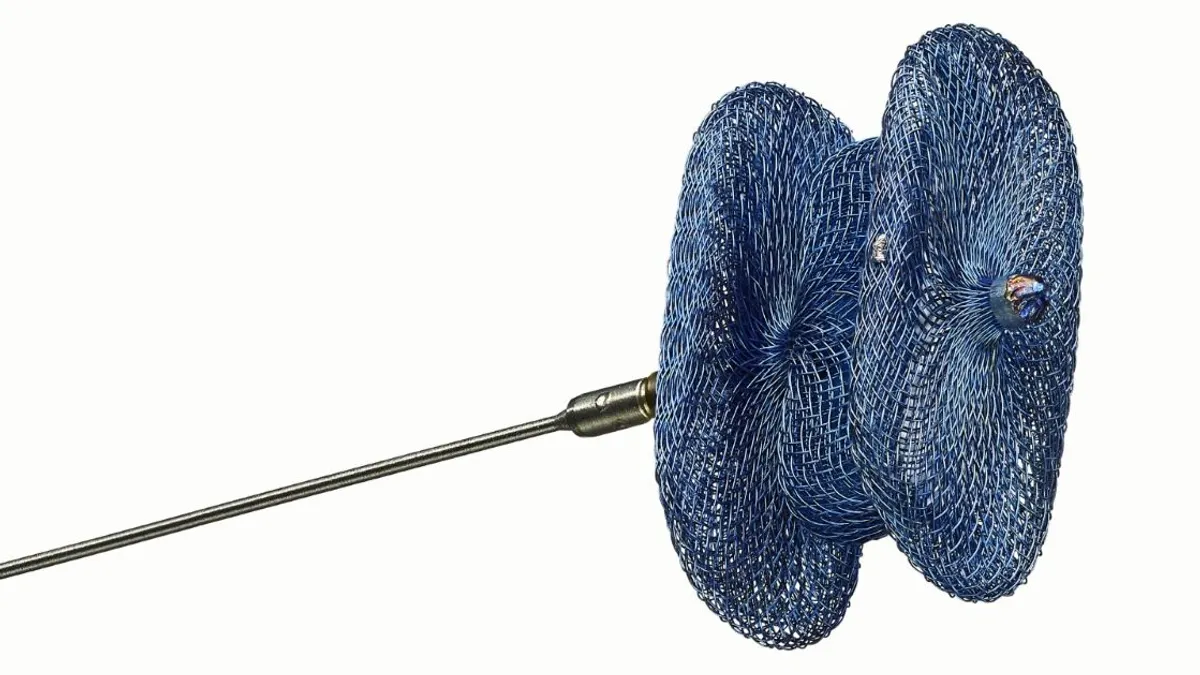
Results from the VERITAS pivotal study showed Abbott’s investigational Amulet 360 left atrial appendage occluder was safe and effective one year after implant.
The next-generation LAA occlusion device is intended to reduce stroke risk in people with atrial fibrillation not caused by a heart valve issue who may need an alternative to long-term blood-thinning medication.
Amulet 360 received Europe’s CE mark in August and is under FDA review. BTIG analysts said the new version of Amulet will allow Abbott to better compete with Boston Scientific’s market-leading Watchman LAA closure device.
The redesigned implant can adapt to a wider range of anatomies and has an outer disc for a second sealing layer to help close off the LAA, Abbott said.
The single-arm VERITAS study, published in JACC: Cardiovascular Interventions, showed complete closure of the LAA in 96.3% of patients evaluated with transesophageal echocardiography. Ischemic stroke or systemic embolism occurred in 1.8% of patients. All-cause mortality was 3.9%, cardiovascular mortality was 1.9% and major bleeding was 6.6%.
Dr. DJ Lakkireddy, executive medical director of the Kansas City Heart Rhythm Institute and president-elect of the Heart Rhythm Society, called the trial results highly encouraging.
“These findings reinforce the potential of the Amulet 360 technology to provide physicians with an effective treatment option as we continue to advance strategies for stroke risk reduction in this patient population," Lakkireddy said in an Abbott statement.