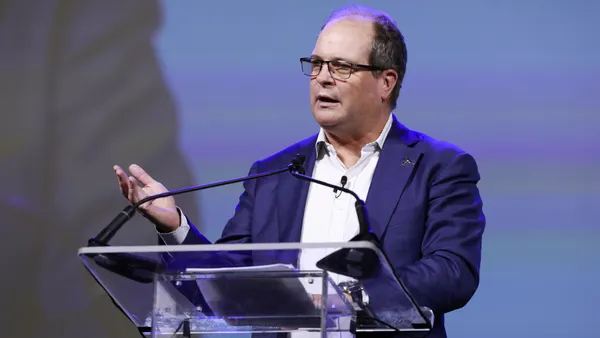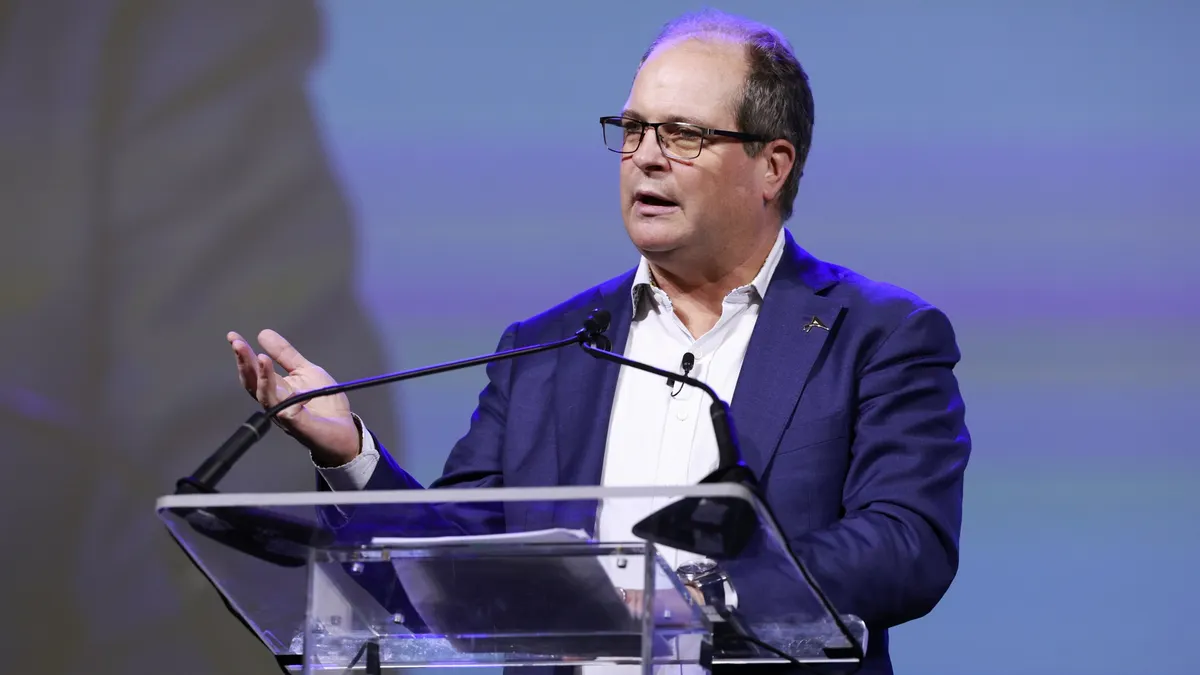
In a year punctuated by cyberattacks, tariffs, inflation and an influx of wearables, medical device firms have a lot to think about. AdvaMed Chairman Mick Farrell is keeping busy.
Farrell recently announced an initiative to develop standards for privacy, interoperability and cybersecurity for the industry group’s members. AdvaMed has been lobbying for adequate Food and Drug Administration staffing, faster coverage of breakthrough devices, and the industry to be spared from the threat of tariffs.
Farrell, who is also CEO of Resmed, has also been partnering with wearables firms. MedTech Dive spoke with Farrell after AdvaMed’s The MedTech Conference to catch up on his priorities and how the device industry is handling recent challenges.
This interview has been edited for length and clarity.
MEDTECH DIVE: Big picture, what are your priorities this year?
MICK FARRELL: Top of mind for me, wearing my Resmed hat, is to help people who are suffocating find their way to screening, diagnosis, treatment and management. We’re doing a couple of things on that front. We talked earlier this year about a strategic alliance with Oura. That intersection between consumer tech and medtech is a huge opportunity for our medtech industry in general, because wearables are proliferating.
What are you thinking about from your perspective as chairman of AdvaMed?
For our whole industry, there's a lot going on right now. We had a really good conversation with [Center for Devices and Radiological Health Director] Dr. Michelle Tarver. All CEOs were invited in the room to say what's working well, what's not working so well and what are the opportunities. So we talked about staffing levels. We talked about 510(k) approval, PMA approval timeframes. We talked about RAPID [Regulatory Alignment for Predictable and Immediate Device Coverage], this idea of syncing up FDA and [the Centers for Medicare and Medicaid Services] for these emerging technologies. From the AdvaMed perspective, a really good relationship with FDA. Also our relationship with CMS, with Dr. [Mehmet Oz], and broader with HHS, with [Robert F. Kennedy Jr.] and so on. I think we’ve got a really good relationship as well there from our medtech industry.
Obviously, there's things like tariffs that we are working with the White House to try and make sure that we protect manufacturing in Mexico or Dominican Republic and others, that these “friend-shoring” areas are covered as well. You multiply across our whole industry, you're talking hundreds of billions of dollars of manufacturing that's already in the U.S. and that we plan to expand.
In a panel on supply chain at the conference, companies mentioned challenges with getting semiconductors and other components. What impacts are you seeing and how are companies reacting?
On the semiconductor side, it’s not quite where we were [in 2021]. We had Gina Raimondo, who was a former governor up here in New England, and she was head of the Department of Commerce. She was going on TV and saying, "Listen, we need more semiconductors for medtech.” Very different today.
The AI boom is taking a lot of the oxygen in the room. A lot of the capital investment. Which means a lot of the semiconductors and a lot of the materials and a lot of manufacturing is focused on those GPUs for Nvidia and the chips from AMD and Micron and Qualcomm and all those all those semiconductor companies. We’re able to still get access. The trouble is the cost. There's inflation.The Strait of Hormuz closure means fuel is more expensive. So whether it's diesel in the boat or jet fuel in that plane, those costs are going up.
It's tough for our customers, and we're not immune to these freight and logistics and semiconductor costs. And so probably what you're hearing on the panel is people are having to raise prices. And with tariffs, for the companies that are paying those, some of those costs will be passed on to consumers and to payers as well. Our goal is to mitigate those as best as possible, and to also explain to the White House that medtech is a very U.S. centric industry. Some of that is aligned with this with this administration, but a lot of it is … We had to rent a 777 from Air Canada to fly ventilators in 2021. We rented that plane from them to bring ventilators over because freight was difficult to come by in 2021. We're not seeing extremes like that. What we learned during that COVID crisis is, if the vast majority of your customers are here in the U.S., why don’t you have more manufacturing here?
Earlier, you introduced an initiative around privacy, interoperability and cybersecurity. Can you tell me a little more about what you’re hoping to see with this effort and what you’re going to provide to medtech companies?
We've spent a decade digitizing medtech, and I think now that we've got a division [at AdvaMed], and every company is starting to embrace at least some level of digital within their medical device, you have to embrace it because it's coming. The question is what do you do?
Our AdvaMed Digital Health Division is working on standards for cybersecurity, privacy and interoperability. We're not done yet. The work is ongoing, but as an industry, we're going to help create the best practices standard.
What does privacy mean? For me, it’s very simple. We don’t own the data. We are stewards of the data. A bank keeps your money, but they don’t own the money. You own the money. They are stewards to keep that banking account, and to make sure it's private and it's secure and it can't be hacked, but it's interoperable — you can get it on Zelle and you can pay from your phone. The fintech industry has actually established pretty strong rules around privacy and cybersecurity and interoperability. We don't have to invent things here.
It’s been a tough year for cybersecurity across multiple industries, and there have been many high-profile attacks within medtech. Is this a wake-up call?
I think everybody knew the importance of cybersecurity. It's impossible to not recognize that. At our CEO summit earlier this year, before some of these headline stories, we had a whole session with experts from the U.S. government talking about, “Hey, this conflict with Iran will lead to cybersecurity issues.” So be alert, be wary, have vigilance, and have resilience, because everybody is going to get hacked. The vigilance is being aware of that and watching. And then the resilience is, how do you shut down the systems, reboot the systems, and get them back up and running?
And then there were some headline stories with major folks, and some of [the hackers] were nation actors, and for that you need a whole industry coming together, and you need also to partner with the government. The wake-up call was already there, but then when you see the headlines, you start to go, “Okay. Let's double down on that.” You don't have to argue with your board of directors to allocate capital to cybersecurity now, right? It's real, and we're all investing in vigilance, resilience and ongoing care. But always keeping the patient at the center.