Dive Brief:
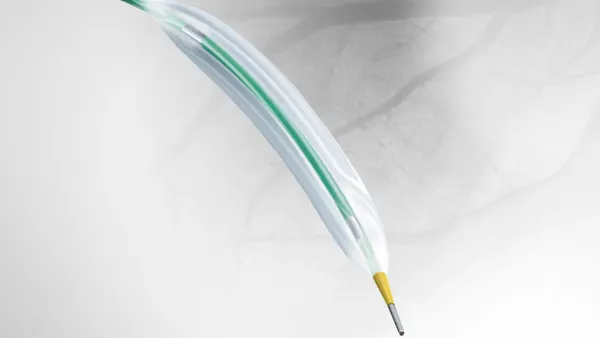
- Johnson & Johnson has launched a new iteration of its Shockwave coronary intravascular lithotripsy catheter that is designed to make it easier for physicians to treat complex calcified lesions and restore blood flow in the arteries.
- Called Shockwave C2 Aero, the improvements in the fifth-generation platform are intended to allow clinicians to use the catheter in a broader range of cases.
- The device is available in the U.S. and Japan and will be introduced in Europe and Canada in the coming months, J&J said Tuesday.
Dive Insight:
J&J is out front in the IVL market following its $13.1 billion acquisition of Shockwave Medical in May 2024. Stryker, Boston Scientific and Abbott are also looking to enter the market.
The Shockwave business is a top growth driver for J&J, generating $305 million in sales in the first quarter, up 18.5% year over year.
The technology delivers pulses of ultrasonic acoustic pressure waves to crack hardened calcium in blocked arteries and re-establish blood flow.
The latest generation of the catheter is designed to be more flexible and easier to reposition during the procedure, to facilitate the treatment of more complex patterns of calcification.
“By continuing to address real unmet physician needs like deliverability, crossability and repositioning, Johnson & Johnson is pushing expectations for what the technology can achieve in complex PCI procedures,” Margaret McEntegart, director of the complex percutaneous coronary intervention program at Columbia University Medical Center/New York-Presbyterian Hospital, said in a J&J statement.
Benjamin Honton, interventional cardiologist at Clinique Pasteur in Toulouse, France, said earlier versions of the technology required physicians to rely on additional devices for positioning during the procedure. The new J&J catheter enables easier repositioning of the balloon, he said.
“This added flexibility facilitates the treatment of more complex patterns of calcification and supports more tailored pulse delivery strategies, including in multivessel disease, expanding what can be achieved with intravascular lithotripsy,” said Honton.